


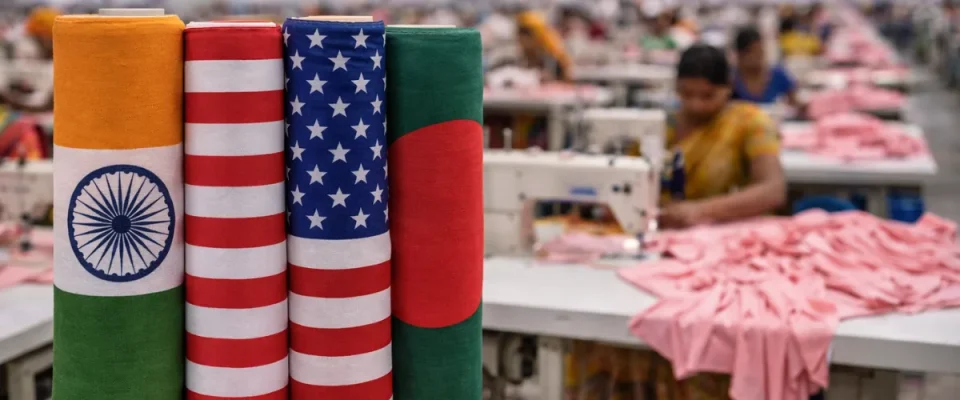
Indian textile stocks decline after reports of a US–Bangladesh zero-tariff clause spark concerns over export competitiveness and order flows.
Shares of several Indian textile companies came under pressure after the United States and Bangladesh announced the conclusion of a reciprocal trade agreement. Stocks that had earlier rallied on optimism surrounding the India–US trade framework reversed gains, with companies such as Gokaldas Exports, KPR Mill, Arvind and Pearl Global Industries falling by over 5 per cent during the trading session.
The sell-off reflected investor concerns that preferential access promised to Bangladeshi textiles under the US deal could dilute the competitive advantage Indian exporters were expected to enjoy in the American market.
What the US–Bangladesh agreement states
The US and Bangladesh have finalised a bilateral trade agreement after nine months of negotiations, aimed at strengthening economic cooperation. Under the pact, reciprocal tariffs on Bangladeshi goods will be reduced to 19 per cent, lower than the rates initially proposed under Executive Order 14257 issued on April 2, 2025. This is slightly higher than the 18 per cent reciprocal tariff agreed for Indian textile exports under the India–US trade framework.
The key area of concern for Indian exporters, however, lies in a specific provision related to textiles and apparel. According to the joint statement, the US has agreed to put in place a mechanism allowing a certain quantity of Bangladeshi textile and apparel exports to enter the American market at zero reciprocal tariff. The eligible volume will be linked to Bangladesh’s imports of US-origin textile inputs such as American cotton and man-made fibres.
This clause has triggered fears that Bangladesh could regain a pricing advantage in the US apparel market despite the higher headline tariff rate.
India’s export expectations before the Bangladesh clause
Before the US–Bangladesh announcement, expectations were high that Indian textile exports would gain significant traction in the US market. The India–US trade framework was widely viewed as a major opening into the US’s $118 billion global textile and apparel import market.
The government noted that the US is already India’s largest textile export destination, accounting for exports worth about $10.5 billion. Nearly 70 per cent of this comprises apparel, while made-ups contribute around 15 per cent. The textile ministry said the 18 per cent reciprocal tariff would remove a long-standing disadvantage for Indian exporters and improve their relative position against competitors such as Bangladesh, China, Pakistan and Vietnam.
Officials added that the shift in tariff dynamics could encourage global buyers to reassess sourcing strategies in favour of India. The agreement is also seen as an important step towards achieving India’s target of $100 billion in textile exports by 2030, with the US expected to contribute more than 20 per cent of this goal.
Exporter optimism on the ground
Following the India–US announcement, exporters in Tiruppur, the country’s largest knitwear hub, expressed strong optimism. According to PTI, Tiruppur Exporters’ Association president K.M. Subramanian said garment exports to the US could double to ₹30,000 crore over the next three years, potentially creating around five lakh additional jobs.
Subramanian noted that the industry currently employs about 10 lakh people and could see employment rise to 15 lakh over the next three to five years. Another Tiruppur-based exporter said orders that previously went to Bangladesh and other competing countries were expected to shift back to Tamil Nadu following the India–US deal.
Does Bangladesh’s zero-tariff access change the picture?
The proposed zero-tariff window for certain Bangladeshi textile and apparel exports has since moderated this optimism. Market participants fear that even limited duty-free access could weaken India’s newly gained tariff advantage.
However, key details of the Bangladesh provision remain unclear. The agreement does not specify the product categories that will qualify, the volume of imports eligible for zero tariffs, or the timeline for implementation. Since eligibility is linked to the use of US-origin textile inputs, the benefit could be restricted or come at a higher cost for Bangladeshi exporters.
Given these uncertainties, the exemption may not materially disrupt India’s competitive position. Moreover, India and the US are still negotiating the final contours of their trade agreement following the framework announcement, leaving room for India to maintain an edge or remain at least equally competitive in the US market.
India’s advantage in Europe
Even as questions persist over the US market, India has secured a significant breakthrough in Europe. The EU–India trade agreement announced on January 27 grants India immediate zero-duty access to the European Union’s $263 billion textile market, with tariffs on textile imports set to be eliminated.
CareEdge Ratings described the EU deal as critical for improving India’s global competitiveness, estimating that India’s share of the EU textile market could rise to 9 per cent from the current 5 per cent. This could translate into an additional $4.5 billion in annual exports over the medium term.
The agreement also reshapes competition with Bangladesh in Europe. Bangladesh has long benefited from preferential access to the EU as a Least Developed Country. With India now enjoying zero-duty access as well, that advantage is significantly reduced. While Bangladesh may not lose market share immediately, it will now compete with India on more equal terms—where India has a more integrated textile ecosystem and strong policy backing, including incentives announced in the Union Budget on February 1.
Balanced outlook despite short-term volatility
Overall, while the US commitment to explore zero-tariff access for some Bangladeshi textile exports has unsettled Indian markets, the long-term impact on India’s export prospects remains uncertain. Lack of clarity on volumes and product coverage, ongoing India–US negotiations, and India’s strengthened position in Europe suggest that the broader outlook for Indian textiles remains intact.
Rather than reversing India’s momentum, the Bangladesh exemption may turn out to be a limited concession with narrow scope. The sharp market reaction so far appears driven more by uncertainty than by any definitive shift in India’s improving global trade position.