
Post-Budget textile consultation outlines roadmap for employment, sustainability and industry growth following key Union Budget announcements.
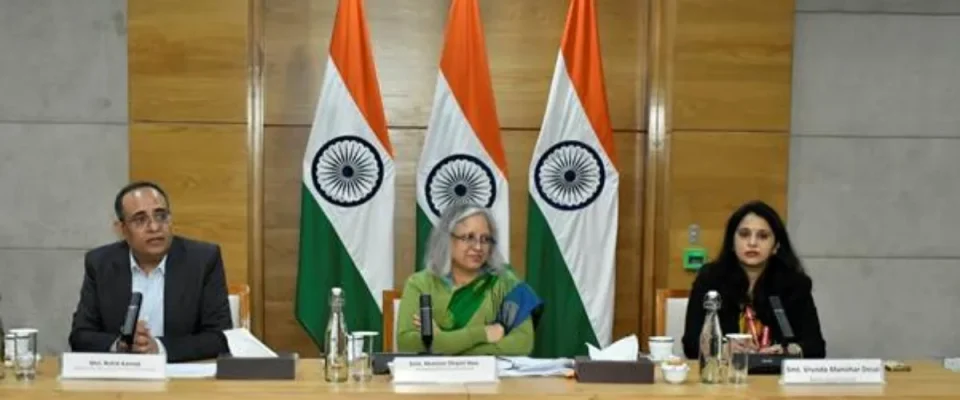
The Ministry of Textiles held its first post-budget National Industry Consultation at Vanijya Bhawan on 19 February 2026, bringing together senior government officials, industry leaders, financial institutions, development partners and stakeholders from across the textile value chain. The consultation aimed to discuss implementation priorities following key announcements made in the Union Budget 2026.
Discussions centred on operationalizing two major budget initiatives — the Textile Expansion and Employment (TEEM) Scheme and the Tex Eco Initiative — both designed to enhance competitiveness, promote modernization, strengthen sustainability and generate employment across the textile and apparel sector.
Delivering the opening address, Rohit Kansal noted that the Union Budget carried a strong textile focus, particularly on employment creation and manufacturing expansion. He highlighted that the introduction of an integrated programme for the sector offers a cohesive framework to align investments, policy interventions and institutional support across the value chain. He added that the budget clearly signals the government’s intent to scale up manufacturing capacity, reinforce domestic capabilities and position textiles as a key contributor to inclusive economic growth.
In her special address, Neelam Shami Rao said that despite global economic challenges over the past year, the outlook for India’s textile industry has turned increasingly positive. She pointed out that recently concluded Free Trade Agreements are opening up new export opportunities, improving tariff competitiveness and strengthening India’s integration into global value chains. According to her, the combination of expanded market access and a textile-centric Union Budget creates a strategic window for the industry to accelerate production, attract investment and expand its global presence.
A detailed presentation on the TEEM Scheme outlined a roadmap focused on modernising weaving, processing and garmenting segments, mobilising investments, enhancing MSME participation and creating large-scale employment opportunities. This was followed by an overview of the Tex Eco Initiative, which seeks to embed sustainability, circularity, resource efficiency and green manufacturing practices throughout the textile value chain.
The interactive session witnessed active participation from industry stakeholders, who welcomed the forward-looking structure of both initiatives and endorsed the integrated approach to addressing structural gaps while capitalising on global opportunities. Participants shared practical suggestions including faster approvals, improved access to MSME financing, development of cluster infrastructure, targeted skilling programmes, digital monitoring mechanisms and sustainability-linked incentives. Many also emphasised the need for alignment with state-level policies and export promotion measures.
Summing up the discussions, Rohit Kansal reiterated the Ministry’s commitment to working closely with industry to convert policy intent into measurable outcomes. He thanked stakeholders for their constructive feedback and stated that such structured consultations would continue to guide responsive and effective policymaking. Industry representatives were encouraged to submit detailed written inputs to support timely finalisation and smooth implementation.
The session concluded with a vote of thanks by Vrunda Manohar Desai, who acknowledged the valuable contributions of participants and reaffirmed the Ministry’s focus on time-bound and outcome-oriented execution.
The post-budget consultation marks a significant step in strengthening structured engagement between the government and industry and in advancing a coordinated roadmap to position India as a credible, competitive and sustainable global textile hub, underpinned by scale, reliability and environmental responsibility.