
Union Budget 2026 anchors Gram Swaraj and fibre schemes to drive an integrated push for India’s textile value chain and rural growth.
The Union Budget 2026–27 has placed the labor-intensive textile sector at the core of India’s growth and employment strategy, unveiling a comprehensive set of initiatives to strengthen the entire value chain — from natural fibres and traditional crafts to technical textiles and future-ready skills.
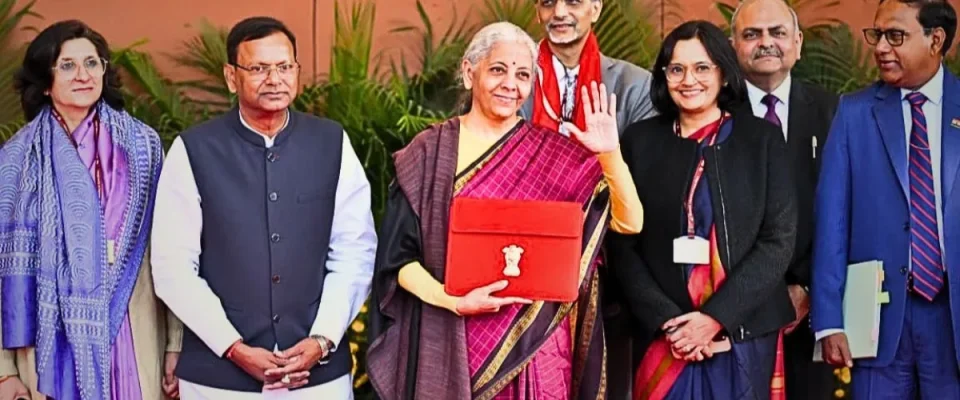
Presenting the Budget, Finance Minister Nirmala Sitharaman announced a National Fibre Scheme aimed at promoting self-reliance across natural fibres, man-made fibres and new-age textile materials. The move signals a shift towards building depth across the full textile value chain rather than focusing on select segments. To enhance employment generation and global competitiveness, the government will roll out textile-specific employment schemes, with emphasis on technology upgradation and targeted support for small and medium enterprises, the finance minister said.
At the heart of the Budget’s textile push is the Mahatma Gandhi Gram Swaraj Initiative, which seeks to strengthen khadi, handloom and handicrafts. The initiative will support global market linkages and branding of Indian textile products, while streamlining training, skilling and quality standards to help artisans and weavers compete more effectively in domestic and international markets.
To further boost employment, the Budget proposed a Textile Expansion and Employment Scheme, under which traditional textile clusters will be modernized through capital support for machinery, technology upgradation, and the creation of common testing and certification facilities to improve productivity and job creation.
The Budget also proposes to integrate handloom and handicraft programmes under a national framework, providing targeted support to traditional artisans, improving market access, and ensuring better alignment with contemporary consumer demand. Underscoring sustainability, Sitharaman announced eco-focused initiatives to encourage environmentally responsible production practices across the textile ecosystem.
On the skilling front, the government will launch Samarth 2.0, an upgraded version of the existing scheme, aimed at modernising the textile skilling ecosystem and aligning training programmes with evolving industry needs. The finance minister also said that mega textile parks will be taken up in challenge mode, with sharper focus on attracting investments in technical textiles, a segment seen as critical for exports and industrial diversification.
Overall, the integrated package reflects the government’s effort to position textiles as a key growth and employment engine, balancing modern manufacturing, sustainability and India’s traditional strengths.
News Courtesy : Economic Times