
How textile start-ups move from exposure to real industry adoption
In our previous article, we explored how start-ups at ITMA 2023 Start-Up Valley gained visibility and early recognition within the global textile community.
Initial exposure, however, is only the starting point.
What ultimately defines success is what happens next — how quickly start-ups move from initial interest to real-world application, integration and commercial growth.
The next group of start-ups from ITMA 2023 demonstrates how early exposure can translate into meaningful industry engagement and tangible business outcomes.
Turning innovation into industry adoption
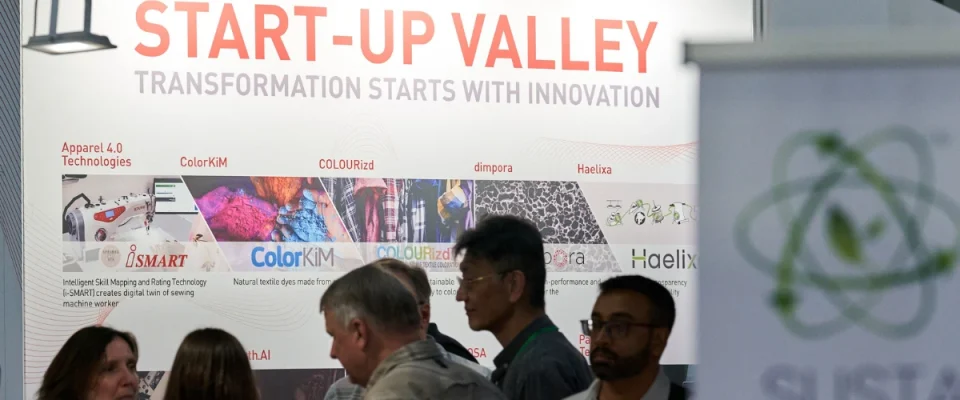
Breakthrough dyeing, AI-powered laundry automation and next-generation fibre traceability were among the innovations spotlighted at ITMA 2023’s Start-Up Valley.
Companies such as COLOURizd, sewts and Haelixa demonstrate how early-stage technologies can move beyond concept, attracting industry attention, forming partnerships and progressing towards real-world application.
Their journeys reflect a critical shift: from visibility to validation, and increasingly, towards commercial adoption.
“Participating in the ITMA 2023 Start-Up Valley was definitely one of the best decisions we’ve made as a company,” says Jennifer Thompson, CEO of COLOURizd, the developer of QuantumCOLOUR™, a patent-pending technology for dyeing fabrics that eliminates harmful chemicals while significantly reducing water and energy consumption.
“For a technology like ours, a capital equipment investment that changes how mills colour yarn, being on that floor, in that room, with the right people, is irreplaceable,” Thompson adds.
“You can’t close those kinds of conversations over email, and we came away with over 300 meaningful contacts from mills, brands and industry partners.”
Her experience highlights how ITMA’s Start-Up Valley acts not just as a showcase, but as a catalyst for validation, investment and industrial adoption, bringing together innovators and decision-makers at the point where solutions are tested against real-world demands.
For start-ups seeking to move beyond early exposure, whether through partnerships, investment or industrial validation, this kind of access can be decisive.
COLOURizd, with operations in North Carolina and Hong Kong, was one of 15 start-ups supported by CEMATEX to exhibit at the first Start-Up Valley. While the initial visibility was important, the longer-term impact has proved far more significant.
In the months following ITMA 2023, funding discussions accelerated, partnerships were formalised, and its technology moved decisively from prototype into industrial evaluation.
For early-stage innovators weighing different growth pathways, from private capital to small business start-up grants, such progress can significantly strengthen the case for scaling.
“Our conversations at ITMA 2023 in Milan evolved into active mill trials, inline production runs and brand evaluations across multiple fibre categories,” Thompson says. “That progression simply wouldn’t have happened at the same pace without that initial exposure.”
This reflects a broader pattern seen across Start-Up Valley participants, where early exposure leads to industry validation and, increasingly, to commercial application.
Munich-based sewts secured a €7 million Series A round within weeks of ITMA 2023, enabling it to accelerate the rollout of its Velum system.
Velum applies artificial intelligence, computer vision and robotics to automate labour-intensive handling processes in industrial laundries – an area that has long resisted automation despite broader advances across textile manufacturing.
While washing and drying processes are already highly mechanised, critical handling steps remain manual. In particular, feeding textiles into folding machines, ensuring correct alignment and wrinkle-free presentation, continues to rely heavily on human labour. By automating this stage, sewts addresses one of the last persistent inefficiencies in the system.
“Even though there is special machinery for almost every manufacturing step in a laundry, complex handling tasks between them are still predominantly manual,” explains sewts co-founder and CTO Tim Doerks. “Automation has not yet made significant headway in this area, which is what we are now effectively addressing.”
Velum has progressed rapidly from demonstration to full industrial installations, with ongoing software updates expanding its capabilities and adaptability across different textile types and operating environments.
For sewts, ITMA provided more than initial exposure. It enabled direct access to a global network of potential customers and partners, accelerating both investment and deployment.
Zurich-based Haelixa, a spin-off from the Swiss Federal Institute of Technology, represents a longer but equally significant scaling journey. In February 2026, the company secured a further €2 million in funding to support the global expansion of its DNA-based traceability technology.
Haelixa’s solution introduces a physical marker into textile fibres, enabling products to be traced back to their origin with certainty. As regulatory scrutiny increases and brands face growing pressure to demonstrate transparency, authenticity and compliance, such capabilities are becoming essential rather than optional.
Crucially, Haelixa’s participation in ITMA 2023 led directly to industrial adoption. Barmag, now part of the Rieter Group’s Manmade Fibres Division, announced that all products manufactured on its systems will incorporate Haelixa’s DNA markers, embedding traceability into the production process itself.
“The unique Haelixa DNA carries the ‘roots’ of the fibres into the everyday life of the end consumer,” says Barmag CTO Jochen Adler. “Once integrated, it becomes irremovable and enables a new level of traceability within existing production systems.”
This demonstrates how technologies introduced at Start-Up Valley can move beyond concept and into industry-wide application when aligned with clear market demand and supported by the right partners.
Scaling towards commercial readiness
For COLOURizd, one of the most significant outcomes of ITMA 2023 was validation by The Woolmark Company, a development that proved transformative both commercially and technically.
“Start-Up Valley put us in front of an audience that understood what we were showing them,” Thompson says. “Woolmark’s validation changed the trajectory of our company.”
Initially positioned as a solution for cellulosic yarns, QuantumCOLOUR™ has since been demonstrated across a wider range of fibre types, including wool, synthetics and blends, without requiring fibre-specific chemistry adjustments. This has significantly expanded its market potential and accelerated its path towards commercial deployment.
Further testing has also revealed strong performance in recycled yarn applications, where maintaining fibre integrity remains a key challenge. In these cases, the process not only avoids degradation but can also enhance yarn strength, supporting both sustainability and performance objectives.
“We are now fully commercialised and QuantumCOLOUR™ is an industrial-scale production system, not a lab prototype,” Thompson says. “Active mill trials are ongoing across multiple fibre categories and geographies, and we expect our first installations within the next 12 months.”
A platform for real industry progress
Beyond individual cases, these experiences reflect a broader shift across the textile industry.
As sustainability pressures intensify, labour challenges persist and traceability becomes a regulatory requirement. The demand for scalable and proven technologies is increasing rapidly.
In this context, ITMA’s Start-Up Valley serves as a critical convergence point, bringing together start-ups, manufacturers, brands and investors in a single environment, and shortening the path from concept to commercial reality.
The next phase of this journey is already taking shape.
Start-Up Valley returns at ITMA 2027
For start-ups developing technologies in advanced materials, automation, digitalisation or sustainability, the opportunity is not just to be seen — but to be evaluated, adopted and scaled within the global textile industry.
20 promising start-ups will be selected for ITMA 2027 Start-Up Valley.
Those selected will gain direct access to manufacturers, brands and technology partners actively seeking solutions.
This is supported by a fully subsidised exhibition presence, dedicated pavilion exposure and global marketing reach, the same platform that has enabled start-ups from ITMA 2023 to secure funding, partnerships and industrial deployment.
If you are ready to move beyond early-stage exposure and accelerate your path to commercialisation, this is where it happens.