

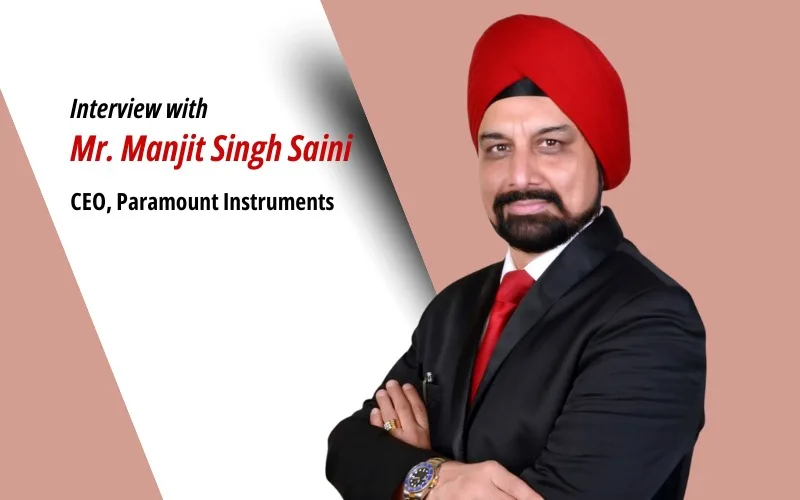
Interview with Mr. Manjit Singh Saini, CEO, Paramount Instruments
“Designed to reduce fatigue, simplify workflows, and deliver consistent accuracy because ease and operator comfort drive reliable results.”
TexMart : “Making testing a joy” What inspired Paramount Instruments to build such an innovative and user-friendly testing brand?
Manjit Singh Saini : Textile testing was long viewed as tedious, stressful, and highly operator dependent. We strongly believed that accuracy and ease could coexist without compromise. “Making testing a joy” emerged from our intent to humanize precision designing instruments that are intuitive, safe, reliable, and dependable. This philosophy ensures that operators feel confident and comfortable while maintaining the highest scientific rigor in every test performed.
TM : Over the years, what key challenges in textile labs pushed Paramount Instruments to focus on precision engineering and comfort-driven instrument design?
MSS : We repeatedly observed at our client’s labs, fatigue-induced errors, inconsistent results, and excessive reliance on individual manual skill. These challenges often increased retesting, delays, and operational stress in busy labs. Such gaps motivated us to engineer instruments that reduce physical strain, simplify workflows, and deliver repeatable accuracy under real production pressures. Ease, simplicity, and operator comfort have therefore become central to our design philosophy.
TM : How did your early R&D collaborations with textile institutes influence the foundation and future direction of Paramount?
MSS : Our collaborations with research centers (I.I.T. Delhi) and textile institutes (T.I.T. Bhiwani etc.) grounded us in real-life testing environments rather than controlled assumptions. These interactions exposed us to practical constraints, academic benchmarks, and evolving global standards. They helped us align innovation with academic diligence, ensuring our products solve genuine testing challenges and remain future-ready.
TM : GSM AI™ is the world’s first AI-powered GSM system what key technological gaps did your R&D team identify that inspired this breakthrough?
MSS : Traditional GSM testing relied heavily on manual cutters, visual judgment, and operator’s efficiency. Our R&D team identified frequent variations, time loss, and inconsistent results as major bottlenecks. These insights led us to develop the world’s first AI-powered GSM system enabling faster testing, and unmatched repeatability. The result is consistent accuracy irrespective of operator experience.
TM : DIGI PICK AI™, with nearly six patents, automates EPI/PPI accuracy. How did the technology evolve from research to final implementation for global markets?
MSS : DIGI PICK AI™ evolved through years of structured research, patent-driven development, and extensive validation on real fabric samples. Multiple iterations were tested to handle fabric diversity, weave variations, and lighting conditions. Each phase focused on accuracy, dependability, and international compliance, ensuring the solution performs reliably across varied fabric samples.
TM : How are your instruments designed to reduce human error and ensure consistent testing results in high-demand textile manufacturing environments?
MSS : Our systems integrate IIOT & machine learning technology, AI-based vision systems, and intelligent algorithms. This integrated approach shifts dependency from individual operator skill to system intelligence. As a result, testing remains consistent, repeatable, and reliable even in high-throughput, multi-shift lab environments.
TM : During ITMA ASIA 2025, your booth attracted global researchers and leaders. What market insights did your R&D teams gather from these interactions?
MSS : Global labs are no longer seeking automation alone; they demand trustworthy intelligence. Accuracy, Repeatability, Data integrity, Traceability, and ease of adoption have become nonnegotiable expectations. These insights reaffirmed our strategic focus on smart, AI-driven, and user-centric testing solutions that integrate seamlessly into existing lab workflows. We feel humbled and honored that our Next Generation instruments were appreciated by industry veterans at Our Booth at ITMA ASIA, Singapore.
TM : The textile industry seeks higher automation how does Paramount balance market expectations with continuous innovation and research initiatives?
MSS : We treat automation as an outcome of deep research, not a shortcut. Every product release is supported by rigorous R&D to ensure durability and long-term relevance. Our IIoT-enabled instruments are designed to be future-proof, with regular Wi-Fi based updates, that evolve alongside market needs.
TM : With global demand shifting toward intelligent testing systems, how do you ensure your innovations remain ahead of competing technologies ?
MSS : We rely on proprietary patents, strong in-house R&D capabilities, and continuous customer feedback loops. Our teams proactively innovate ahead of market demand rather than reacting to it. This forward-thinking approach allows us to set benchmarks instead of following them.
TM : Paramount received appreciation from leaders like the Ministry of Textiles and TAI. How does such recognition shape your long-term business and R&D strategies?
MSS : Such recognition reinforces our resolve to lead with integrity and a human-centric approach. It strengthens our commitment to indigenous innovation, the Make in India vision, and sustained long-term R&D investments. These acknowledgments motivate us to raise industry benchmarks consistently.
TM : What major lessons have you learned from decades of working with Indian and global textile labs, and how do these insights shape your strategies today?
MSS : The most important lesson is that technology must adapt to people, not the other way around. Practical usability, simplicity, quick serviceability, and consistent accuracy drive true adoption. These insights directly shape how we design, deploy, and support our solutions today.
TM : After live demos at ITMA ASIA, how does customer feedback influence your future product development roadmap?
MSS : Live feedback is invaluable because it comes from real operating conditions. It highlights areas for refinement, feature prioritization, and simplification in operation. This feedback directly feeds into our next-generation product planning and roadmap decisions.
TM : From an R&D perspective, how is India’s textile testing ecosystem evolving, especially with the rise of AI tools like GSM AI™?
MSS : India is steadily transitioning from manual testing methods to intelligent, data-driven systems. AI tools like GSM AI™ signify a major shift toward global alignment and standardized accuracy. This evolution enhances India’s credibility in international textile markets.
TM : How do you see Indian textile labs adapting to automation, digital accuracy, and AI-based testing solutions in the coming years?
MSS : The transition will be gradual but decisive. As awareness and exposure increase, labs will prioritize speed, consistency, and digital accuracy. Automation naturally excels in these areas, making adoption inevitable.
TM : What technological barriers still exist in Indian testing labs, and how does Paramount aim to address them through future innovation?
MSS : Key barriers include Lack of Technology, Mindset, Skill gaps, and hesitation to adopt new innovations. Paramount addresses these challenges through intuitive system design, structured training support, and scalable automation. Our goal is to make advanced technology approachable and practical.
TM : Based on your interactions at ITMA ASIA, what upcoming advancements will most influence India’s textile testing landscape in the next 5–10 years?
MSS : AI-led vision systems, IIoT-based quick technical support, digital traceability, and predictive maintenance will redefine textile testing. These technologies will improve uptime, accuracy, and decision-making across labs.
TM : How can advanced tools like DIGI PICK AI™ support India’s vision of becoming a global leader in quality-driven textile exports ?
MSS : DIGI PICK AI™ ensures accuracy, repeatability and dependable real-time results in EPI/PPI testing. This strengthens international buyer confidence and enhances the reputation of Indian textiles in quality-driven markets. Such latest AI driven equipment will substantiate and uphold Indi’s vision of becoming a Global Leader in Hi-Quality textile export.
TM : How important will R&D-driven automation be for the future competitiveness of Indian mills and testing institutions?
MSS : It will be decisive. Quality control labs with Latest IIOT & AI Driven instruments will become prime vehicles and guardians of Product Quality Assurance in Yarns, Fabrics & Garment Export industry. R&D-led automation is no longer optional, it is essential for survival.
TM : Paramount states that every challenge is an “Invitation to innovate.” How does this culture contribute to sustainable and responsible textile development?
MSS : By solving core operational problems such as rework, retesting, and inefficiencies. This directly reduces waste and improves first time right testing outcomes. Sustainability thus becomes a natural byproduct of precision and accuracy.
TM : What CSR or educational collaborations does Paramount engage in to support textile students, research scholars or skill development initiatives?
MSS : We actively collaborate with textile institutes and research centers to support student projects and academic research. We also provide access to advanced testing technologies to help build practical skills and industry readiness. Along with Professional CSR, we also indulge in CSR at human level with our Meditate India Initiative, where we are promoting Health, Peace & Happiness. We strongly believe that any business has a responsibility to give back to the community. Since our customers are our cherished partners, we love to contribute Joy and Peace in their lives, through Yoga & Meditation Sessions.
TM : How do your R&D-led innovations help reduce waste, improve accuracy and support environmentally responsible textile processing?
MSS : IIOT driven and AI enabled instruments optimize resource usage by identifying defects early in the Production Process, reducing material wastage. It also helps minimize energy consumption, contributing to Sustainable Manufacturing practices. Higher testing accuracy leads to fewer retests and reduced fabric wastage. Optimized testing also minimizes resource consumption, directly supporting environmentally responsible textile processing.
TM : At ITMA ASIA 2025, GSM AI™ & DIGI PICK AI™ received strong praise. What does such global recognition mean for your innovation pipeline?
MSS : It validates our strategic direction and strengthens confidence in our innovation roadmap. This recognition accelerates our commitment to deeper, patent-led R&D initiatives with enhanced efforts to make testing and Quality Control Easy, Efficient & Joyful.
TM : How has the overwhelming response at international exhibitions influenced your upcoming R&D events or technology launches?
MSS : Every Time our innovations attract overwhelming response at international exhibitions, it does more than validating our creativity, it ignites our spirit deepens our conviction that magical phrase: “We proudly Make in INDIA for the World.”