


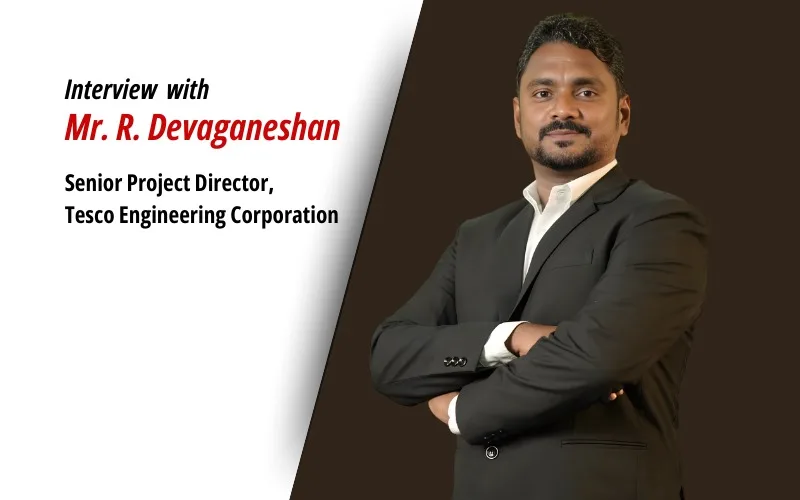
Interview with Mr. R. Devaganeshan, Senior Project Director, Tesco Engineering Corporation
Founded in 2006 in Coimbatore, Tesco Engineering delivers energy-efficient industrial ventilation that combines high airflow, power savings, and long-term reliability.
TexMart : What was the founding vision behind Tesco Fans what gap in the industrial ventilation market were you aiming to fill?
R.Devaganeshan : Tesco Engineering Corporation was founded in 2006 with a clear vision: to address the growing need for energy-efficient, reliable, and cost-effective industrial ventilation solutions, particularly in the textile and heavy-industry sectors. Operating from Coimbatore the hub of India’s textile manufacturing we identified a critical gap in the market where conventional ventilation systems consumed excessive power, offered limited efficiency, and delivered poor long-term ROI. Tesco Fans were developed to bridge this gap by combining high airflow performance with measurable power savings and operational reliability.
TM : In the early days, which industry challenges inspired you to build power saving ventilation solutions for textile and heavy industry use?
RD : Textile mills and heavy industries were facing rising energy costs, excessive maintenance and inefficient airflow management-especially in humidification and cooling applications. These challenges directly impacted productivity and profitability. The lack of retrofit-friendly, power-saving ventilation solutions became the primary catalyst for building Tesco Fans.
TM : Looking back, how did your initial design philosophy evolve when R&D feedback from early customers came in?
RD: Early customer feedback played a pivotal role in refining our design philosophy. Inputs from textile mills highlighted the need for Power Saving, Air flow (RH-Maintenance), and easy installation without civil modifications. This led to the development of ultra-lightweight, aerodynamically optimized blades and plug-and-play systems that deliver consistent performance with minimal disruption.
TM : What core technological innovations differentiate Tesco Fans from conventional industrial fans in efficiency and reliability?
RD : Tesco Fans stand apart due to their blade technology, precision aerodynamic design, and energy-optimized airflow Engineering. Our fans ensuring higher efficiency, longer motor life, and consistent airflow—unlike conventional heavy FRP or Aluminum fans.
TM : How do you ensure product robustness across different industrial conditions (textile mills, steel plants, mining, etc.) what testing protocols do you follow?
RD : Our fans are engineered and tested to perform in demanding environments such as textile mills, steel plants, mining sites, power plants, and outdoor applications. Each product undergoes dynamic balancing, load testing, endurance testing, and real-time field validation, ensuring stable performance across varying temperatures, dust levels, and operational loads.
TM : As many textile mills and industrial plants shift toward energy efficiency, how are you gauging market demand to drive your next innovations?
RD : With rising power tariffs and sustainability mandates, demand for energy-efficient solutions is accelerating. We closely analyze installation performance data, customer feedback and energy-audit outcomes to guide our next innovations.
TM : From your recent installations (e.g. collaboration with textile mills), what market feedback has influenced your product roadmap?
RD : Recent large-scale textile installations especially mills with over 50,000 spindles have reinforced the demand for retrofit-friendly, fast-ROI solutions. This feedback has directly influenced enhancements in blade design, motor compatibility, and scalability.
TM : What new market segments beyond textile mills do you see as ripe for adoption of your ventilation/fan technology, and why?
RD: Beyond textiles, we see strong adoption potential in steel plants, mining, power plants, diesel generator cooling, heat exchangers, agriculture sprayers, and anti-smog systems, where energy efficiency and durability are critical.
TM : After installations in large mills, how do you evaluate performance and customer satisfaction do you have structured feedback & follow-up processes?
RD : Post-installation, we conduct structured performance evaluations, monitoring power consumption, airflow efficiency, motor health, and ROI metrics. Customer feedback and follow ups are integral to our service model.
TM : What are the key lessons from past decades of delivering ventilation solutions that shape your current strategic decisions?
RD : Key learnings include the importance of simplicity in retrofit design, fast ROI, reliability over complexity, and customer-centric engineering all of which define our current and future decisions.
TM : From an R&D standpoint, how is India’s demand for energy-efficient industrial ventilation evolving what technological trends are you observing?
RD : India’s industrial sector is increasingly prioritizing energy efficiency, sustainability and automation. Industries now seek solutions that deliver immediate savings with minimal infrastructure changes. TM : What advancements (in materials, motor efficiency, blade design) do you foresee will shape the next generation of industrial fans in India? RD : The next generation of industrial fans will be shaped by advanced materials, higher motor efficiency, life of the product and smart integration.
TM : What technological or infrastructural limitations in Indian mills pose challenges to implementing advanced ventilation systems, and how are you addressing them?
RD : Many Indian mills operate with legacy systems. Our plug-and-play, retrofit-friendly designs eliminate the need for civil work, motor replacement or duct modifications making adoption seamless.
TM : Given India’s focus on sustainability and energy conservation, how do you foresee the demand for your products over the next 5–10 years?
RD : With India’s strong focus on sustainability and energy conservation, demand for power-saving industrial ventilation is expected to grow exponentially. Tesco Engineering Corporation is well positioned to lead this transition.
TM : What role does R&D play in scaling up operations to meet anticipated growth are you preparing new product lines or custom solutions?
RD : R&D is central to our growth strategy. We are actively developing new product lines, centrifugal fan blades and customized industrial solutions to meet evolving market needs.
TM : How does Tesco Fans consider environmental impact when manufacturing and deploying ventilation solutions (e.g. energy saving, reducing carbon footprint)?
RD : Our products directly reduce energy consumption and carbon emissions, supporting greener manufacturing practices across industries.
TM : Do you have any initiatives to train or educate industrial workers/clients about energy conservation, correct usage and maintenance, thereby promoting sustainable practices?
RD : We actively educate clients and operators on energy conservation, correct fan usage, and maintenance best practices, ensuring long-term sustainability.
TM : How do you ensure that your growth and industrial installations don’t compromise workplace safety or worker welfare in partnering mills?
RD : All installations are designed to comply with industrial safety standards, and safer working environments without compromising worker welfare.
TM : With recent collaborations such as the installations in textile mills across Tamil Nadu how does this recognition influence your upcoming R&D or business plans?
RD : Large-scale installations across Tamil Nadu have strengthened our confidence and accelerated investments in R&D and capacity expansion.