


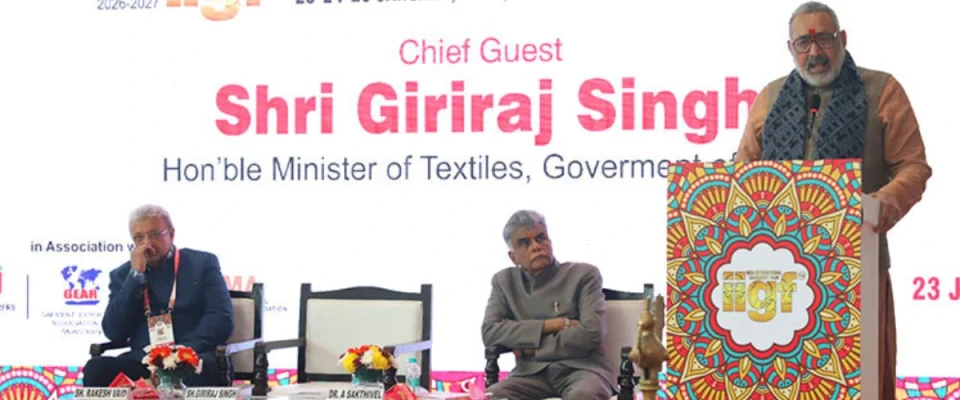
India’s textiles sector has expanded from US$92.4 billion in 2014 to US$176 billion at present, Union Minister Giriraj Singh said.
India’s textiles sector has witnessed substantial growth over the past decade, doubling in size and strengthening its role as a key driver of employment and exports, Union Minister for Textiles Giriraj Singh said. Speaking at the inauguration of the 74th edition of the India International Garment Fair (IIGF) in New Delhi, the Minister said the overall size of the textiles sector had expanded from Rs. 8.4 lakh crore (US $ 92.4 billion) in 2014 to around Rs. 16 lakh crore (US $ 176 billion) at present. He added that the domestic market had also grown sharply, rising from Rs. 6 lakh crore (US $ 66 billion) to about Rs. 13 lakh crore (US $ 143 billion) in 2025, while exports have recorded an increase of more than 25% in the post-pandemic period.
Singh said the textiles and apparel sector had emerged as one of the country’s largest platforms for employment generation, underlining its importance to inclusive economic growth. The Minister said the government had undertaken a series of policy measures to remove structural barriers faced by the industry. These included quality control reforms, higher allocations under export incentive schemes such as the Remission of Duties and Taxes on Exported Products (RoDTEP) and the Rebate of State and Central Taxes and Levies (RoSCTL), temporary reductions in import duties, and corrections to the inverted duty structure. He said the government had extended support of around Rs. 50,000 crore (US $ 5.5 billion) to the sector through the RoDTEP and RoSCTL schemes.
Singh said that despite global headwinds, the industry had remained resilient and stable, aided by a concerted push towards export diversification. He noted that India’s outreach to 40 new export markets was yielding encouraging results, with exports growing by 77% to Argentina, 30% to Egypt, 20% to Poland and Japan, and around 10% to Sweden and France. He added that the signing of the India–European Union trade agreement was a positive development for the sector.
Highlighting India’s structural strengths, the Minister said the country benefits from a young workforce, abundant raw material availability and a foreign exchange surplus, and stressed the need to capitalise on these advantages to achieve sectoral targets.
In his address, Singh also said India was moving away from dependence on foreign benchmarks and was developing its own standards through indigenous initiatives such as VisionNxt and IndiaSize. He said these efforts were aligned with the vision of Aatmanirbhar Bharat and aimed at strengthening India-specific design forecasting and identity. The Minister urged industry stakeholders to increasingly adopt Indian standards as the sector scales up its global presence.
News Courtesy : Apparal Resources