


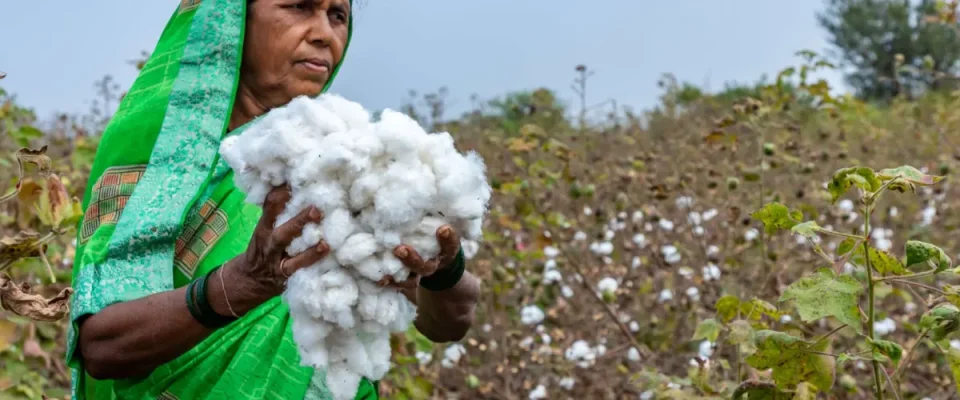
The Union Cabinet, led by Narendra Modi, has approved an outlay of ₹5,659.22 crore for the “Mission for Cotton Productivity,” which will run from 2026–27 to 2030–31.
The initiative is designed to tackle stagnating yields, quality issues, and supply constraints in India’s cotton sector, while boosting its competitiveness in global markets. Aligned with the government’s “5F” vision—Farm to Fibre to Factory to Fashion to Foreign—the mission seeks to strengthen the entire cotton value chain, spanning production through to exports.
A key focus of the programme will be the development of high-yielding, climate-resilient, and pest-resistant seed varieties. It will also promote advanced cultivation methods such as High Density Planting System (HDPS), closer crop spacing, and integrated cotton management practices. Additionally, efforts will be intensified to increase the production of Extra Long Staple (ELS) cotton to meet rising industry demand.
To enhance cotton quality, the government plans to invest in capacity building and the modernisation of around 2,000 ginning and processing units. These upgrades will aim to reduce contamination and improve fibre quality through the adoption of best practices.
The mission will also strengthen cotton testing infrastructure nationwide by establishing standardised and accredited facilities for reliable quality assessment. Branding and traceability initiatives under the Kasturi Cotton Bharat programme will be expanded to position Indian cotton as a premium and globally trusted product.
Digital integration of agricultural markets is another major component, intended to improve transparency in price discovery and ensure better returns for farmers through online trading platforms. The initiative will further encourage recycling of cotton waste and promote circular economy practices within the textile sector.
In addition, the programme aims to diversify the fibre base by supporting alternative natural fibres such as flax, ramie, sisal, bamboo, banana, and milkweed, aligning with global sustainability trends.
The mission will be jointly implemented by the Ministry of Agriculture and Farmers Welfare and the Ministry of Textiles, with support from institutions like the Indian Council of Agricultural Research and the Council for Scientific and Industrial Research. Initially, it will cover 140 districts across 14 major cotton-growing states.
By 2030–31, the mission aims to raise cotton production to 498 lakh bales and increase lint productivity from 440 kg per hectare to 755 kg per hectare. The initiative is expected to benefit around 32 lakh farmers.
According to the government, the programme will help boost farmer incomes, improve quality standards, and strengthen India’s standing in global textile markets, while moving closer to self-sufficiency in cotton production.