
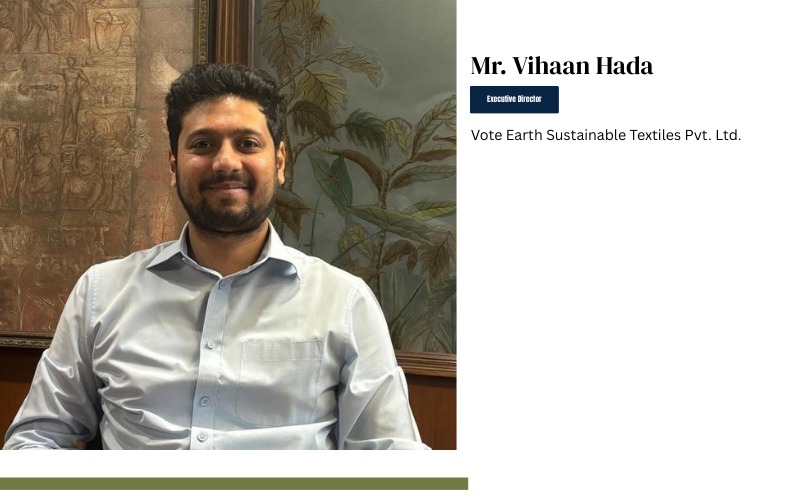
Interview with Mr. Vihaan Hada, Executive Director, Vote Earth Sustainable Textiles Pvt. Ltd.
Vote Earth Sustainable Textiles Private Limited (Vestpl) is an Indian company which manufactures eco- friendly sliver made from a natural flax fibre as well as cottonised bast fibre including Flax, Hemp, Jute.
The team at Vote Earth Sustainable Textiles Private Limited has vast experience in appraising and sourcing the production including flax, hemp and jute. Our company conforms to international standards and maintains regular checks and balances in all aspects of the business. We endeavor to be a “minimum “or “zero waste “generating manufacturing unit as most of our waste by products are re-used in the manufacturing process itself.
Texmart : Vote Earth is grounded in sustainable textile manufacturing—what was the original inspiration behind building an eco-focused textile company in India?
Vihaan Hada : The inspiration behind Vote Earth came from recognizing the gap between India’s rich heritage of natural fibers and the environmental impact of modern textile manufacturing. While biodegradable fibres such as flax are inherently sustainable, they were often underutilized or inconsistent at an industrial scale.
Vote Earth was founded to bridge this gap by focusing on high-quality, processed biodegradable fibres that are reliable, scalable, and suitable for global textile applications. Our objective is to make sustainable raw materials commercially viable and performance-ready, with India as the foundation of this eco-focused manufacturing approach.
TM : How did the idea of producing biodegradable and eco-friendly fibres from natural sources like flax become central to your mission?
VH : As we examined the textile value chain more closely, it became clear that the greatest environmental impact begins at the raw-material stage. Synthetic fibres and chemically intensive inputs dominate the industry, while naturally biodegradable fibres remain underdeveloped and inconsistently processed.
Flax and similar natural fibres stood out because they are renewable, biodegradable, and well-suited to responsible processing. Focusing on processed eco-friendly fibres at the source therefore became central to Vote Earth’s mission, as improving sustainability at this level creates a positive ripple effect across the entire textile supply chain.
TM : How does Vote Earth ensure quality, consistency, and scalability while working with natural, biodegradable fibres?
VH : Working with natural, biodegradable fibres requires a strong emphasis on process control rather than chemical correction. At Vote Earth, quality and consistency are achieved through careful raw-material selection, standardized processing parameters, and continuous monitoring at each stage of fibre preparation. We rely on mechanical and process-led optimization, including controlled cleaning, grading, and fibre refinement, to maintain uniformity and performance. Scalability is built into the system by designing processes that can be replicated without compromising fibre integrity or environmental responsibility, supported by selective mechanization and supplier alignment.
TM : As sustainability becomes a priority for brands and consumers, how do you track market trends to guide your product development roadmap?
VH : We track sustainability-driven market trends through a multi-layered approach that combines continuous engagement with global brands, buyers, and mills, monitoring evolving regulatory and certification standards such as GOTS, GRS, FSC, and OEKO-TEX, and analysing shifts in consumer material preferences like traceability, biodegradability, and low-impact processing.
Insights from industry forums, trade fairs, and R&D collaborations are systematically translated into a phased product development roadmap, enabling us to anticipate demand and align innovation with future sustainability and performance expectations.
TM : How does customer and industry feedback influence your innovation strategy, especially when developing eco-friendly yarns for apparel and fashion?
VH : Customer and industry feedback forms the foundation of our innovation strategy. Inputs from brands, fabric developers, and garment manufacturers help define both technical performance benchmarks—such as strength, uniformity, hand feel, and dyeability—and sustainability objectives.
Our R&D team works closely with customers through sampling, pilot trials, and co-development initiatives, ensuring eco-friendly yarns are not only environmentally responsible but also scalable, cost-effective, and compatible with existing manufacturing ecosystems.
TM : What innovative fiber solutions or sustainable products is your R&D team exploring next to meet future apparel and textile industry needs?
VH : Our R&D efforts are focused on next-generation natural and sustainable fibre solutions, including:
- Advanced natural fibre and blended yarns that enhance durability and performance
- Low-impact, energy-efficient processing technologies
- Bio-based, recycled, and circular yarn systems
- Functional yarns that improve comfort, moisture management, and longevity without heavy chemical dependence.
These initiatives support the industry’s transition toward circularity, reduced environmental footprint, and long-term resource efficiency, while maintaining the quality standards expected by global apparel brands.
TM : How has VESTPL’s strategy evolved to balance sustainable textile manufacturing with commercial scalability in domestic and international markets?
VH : VESTPL’s strategy has evolved by embedding sustainability into its core business model, rather than treating it as a standalone initiative. The company has adopted responsible raw material sourcing, resource-efficient manufacturing practices, and globally recognized sustainability certifications, ensuring environmental compliance alongside operational reliability.
To support commercial scalability, VESTPL has invested in technology upgrades, process standardization, and capacity optimization, enabling sustainable yarns and textiles to be produced at scale without compromising quality or cost competitiveness. By maintaining a balanced market approach—serving value-driven domestic markets while meeting the stringent compliance and performance expectations of international buyers—VESTPL has successfully aligned sustainability, profitability, and long-term growth. From an R&D perspective, what technological gaps currently exist in natural fiber and eco-textiles manufacturing, and how is VESTPL addressing them?
From an R&D standpoint, one of the biggest technological gaps in natural fibre and eco-textiles manufacturing—especially in India—is the lack of end-to-end automation and standardization, particularly for bast fibres like hemp, flax and similar long fibres.
Unlike cotton or synthetics, these fibres still rely heavily on manual or semi-mechanized processing, which leads to inconsistent fibre length, variable cleanliness, and uneven performance at the downstream stage. Hemp processing, in particular, suffers from fragmented infrastructure, limited availability of modern decortication and fibre-opening system…
TM : What role will natural fibers like flax and organic cotton play in shaping India’s future textile landscape?
VH : Natural fibres such as flax and organic cotton are set to play a central role in India’s future textile landscape, particularly as the industry moves toward sustainable, breathable, and climate-appropriate clothing.
At VESTPL, cottonised flax is our main product because it sits at the intersection of sustainability, scalability, and commercial viability. By processing flax to behave like cotton, it becomes compatible with existing cotton spinning infrastructure, allowing it to be blended seamlessly with cotton to create cotton–linen blended yarns. This is critical, because it removes the biggest adoption barrier—new machinery or high capex.
Cotton–linen blends offer a compelling balance of comfort, durability, breathability, and reduced environmental impact, making them ideal for everyday apparel rather than niche or luxury-only use. This is increasingly reflected in global consumption patterns, where brands such as Uniqlo have successfully scaled linen and cotton–linen blends into mass-market, high-volume clothing, demonstrating both demand and repeatability.
Looking ahead, as consumers prioritise natural fibres, low-impact materials, and comfort in warm climates, cottonised flax and organic cotton blends are likely to move from being an alternative to becoming a mainstream default in apparel—especially for shirts, casual wear, summer clothing, and workwear. India, with its strong cotton ecosystem and growing focus on sustainable processing, is well positioned to lead this shift.