


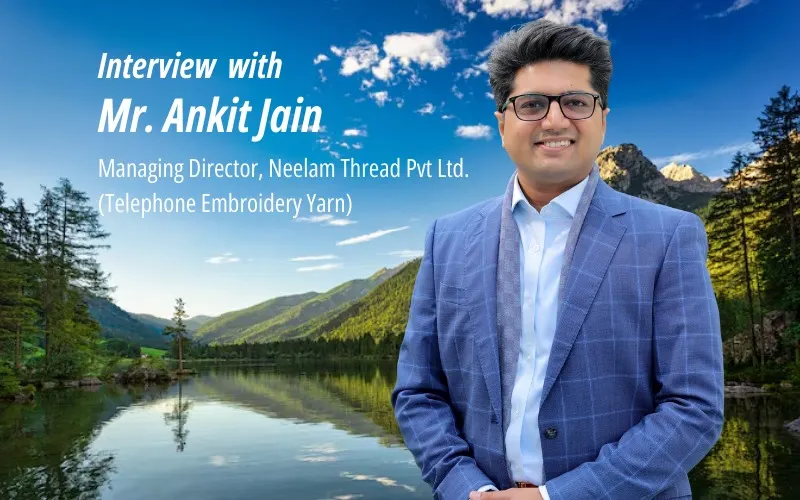
Interview with Mr. Ankit Jain, Managing Director, Neelam Thread Pvt Ltd. (Telephone Embroidery Yarn)
Engineered precision, tested performance our threads deliver smooth, reliable embroidery across every material and category.
TexMart : Telephone Threads began in 1979 under the vision of Shri Satender Kumar Jain what inspired the founding mission of providing high-quality embroidery threads to Indian and global markets?
Ankit Jain : Telephone Threads was founded in 1979 by Shri Satender Kumar Jain with a clear and purposeful vision. At that time, the Indian embroidery and garment industry had limited access to consistent, high-quality embroidery threads, especially those matching international standards. Threads were not easily available, while local options often lacked uniformity, strength, and colour brilliance. He was inspired to bridge this gap—to create an Indian brand that could deliver world-class embroidery threads with reliable quality, vibrant colours shades. His mission was to empower Indian manufacturers and designers with globally competitive threads, while also building a brand that could proudly serve international apparel brands. This commitment to quality, innovation, and trust became the foundation of Telephone Threads and continues to guide the brand even today.
TM : How has the company’s legacy of craftsmanship and quality defined your brand purpose from the start to where you are today?
AJ : Craftsmanship and uncompromising quality have been at the core of Telephone Threads. This foundation defined our purpose—to create embroidery threads having wide range of 600 colour shades that perform flawlessly and elevate design. Over the years, this legacy has evolved into a commitment to innovation, reliability, and responsible growth, while preserving the standards that built trust across generations.
TM : From an R&D perspective, what foundational challenges in thread quality and machine compatibility motivated early technical development?
AJ : In the beginning, the main challenge was making threads that were consistent in colour matching and machine-friendly. Problems like frequent breakage, uneven thickness, colour variation affected embroidery quality. This led to early R&D efforts focused on stronger, smoother threads with uniform colour, so they could run easily on embroidery machines and give reliable results.
TM : Telephone produces viscose rayon, spun polyester, trilobal polyester and metallic threads how do you ensure superior performance and consistency across such diverse product categories?
AJ : We ensure superior performance across all thread types through strong R&D, strict process control, and quality testing at every stage. Each material has its own technical parameters for yarn selection,dyeing, lubrication, and finishing, tailored for smooth machine performance. Consistent lab testing, shade control, and machine trials ensure reliability, uniformity, and high-quality results across viscose rayon, spun polyester, trilobal polyester, and metallic threads. Regular machine trials and lab testing ensure all our threads run smoothly and deliver reliable embroidery results, no matter the category.
TM : As embroidery machines become faster and more automated, how does your R&D team adapt thread formulations to minimize breakage and maximize operational efficiency?
AJ : As embroidery machines become faster, our R&D adapts by making threads more uniform, stronger, and machine-friendly. We optimise yarn structure, twist balance, and tensile strength to reduce friction at higher speeds. We also improve dye fixation and RF drying stability so threads perform consistently during long runs. In addition, we conduct high-speed machine trials, needle compatibility tests, and continuous feedback from customers to refine formulations—resulting in less breakage, smoother running, and higher productivity.
TM : With over 600+ colours and multiple thread types, how do you analyse market trends to expand your thread portfolio while retaining high quality?
AJ : We closely track fashion trends, designer feedback, and buying houses of Global brands to identify new colour and thread needs. Customer inputs, seasonal palettes, and buyer specifications guide our portfolio expansion. At the same time, every new colour or thread goes through lab testing, shade approval, and machine trials, ensuring we expand our range without compromising on quality or consistency.
TM : Exporters and fashion brands demand precision colour matching how does Telephone Threads align innovation with global market expectations?
AJ : We align innovation with global expectations through advanced shade development and strict colour control systems. Export standards, Pantone references, and brand swatches guide our colour creation, while a spectrophotometer is used for precise colour matching and repeatability. Each shade undergoes lab validation, batch-wise consistency checks, and machine trials, ensuring accurate colour, uniformity, and reliable performance for both domestic and international fashion apparel brands.
TM : Looking ahead, what innovative thread solutions (e.g., recycled or performance threads) is your R&D exploring to meet emerging fashion and textile needs?
AJ : Looking ahead, we are focused on sustainable and performance-driven innovations. We already offer FSC-viscose rayon threads, supporting responsible sourcing. In addition, we are actively working on GRS recycled embroidery threads, which will be launched soon to meet growing sustainability demands. Alongside this, we have already started high-performance matte finish embroidery threads with improved strength and machine efficiency.
TM : How has your strategy evolved to balance domestic demand with the needs of global embroidery and garment manufacturers?
AJ : We serve Indian manufacturers with fast availability, wide colour ranges, and local distribution channels, while meeting global brands requirements through export-grade quality, precise colour matching, and compliance standards. This balanced approach allows us to respond quickly to local trends while consistently supporting embroidery and garment manufacturers.
TM : What quality control practices and lab systems have you implemented to ensure stitch reliability and colour fastness for high-volume production?
AJ : Our in-house lab conducts tensile strength, elongation, and colour fastness tests, supported by spectrophotometer-based colour matching. We also use automatic winding machines to ensure uniform winding, higher productivity, and consistent quality. Batch-wise inspections, controlled dyeing, and regular embroidery machine trials help maintain stable stitching and minimal breakage even in high- volume production.
TM : As digital textile production grows, what business experiences have influenced how you integrate customer feedback into future product strategy?
AJ : Our business experience has shown that the most valuable insights come directly from the shop floor. Inputs from garment exporters, designers, embroiderers and machine operators help us understand real production challenges—such as speed, colour accuracy, and thread breakage performance. We actively use this feedback to refine thread specifications, develop new shades, and plan future product launches, ensuring our strategy stays aligned with evolving customer and market needs.
TM : Over four decades, India’s textile and thread manufacturing technologies have advanced how has Telephone Threads adapted to industry shifts such as computerized embroidery systems?
AJ : Over the years, we have continuously upgraded our dyeing processes, focusing on better efficiency and sustainable practices. We operate ETP plants for responsible water treatment and use solar-powered energy to reduce our environmental impact. At the same time, we have strengthened our systems to connect more closely with suppliers and customers, improving coordination, transparency, and long-term relationships—ensuring consistent quality and reliable service as the industry evolves.
TM : How important are automated testing labs, spectrophotometers and dye-fastness equipment in maintaining product standards for high-speed embroidery applications?
AJ : Automated testing labs are critical for maintaining product standards in high-speed embroidery. Tools like spectrophotometers ensure precise colour matching and repeatability, while dye-fastness and strength testing equipment confirm durability under continuous machine operation. Together, these systems help reduce breakage, avoid shade variation, and deliver consistent, reliable performance at industrial embroidery speeds.
TM : What barriers still exist in India’s thread technology landscape, and how do you see R&D helping overcome issues like colour variation or breakage at ultra-high machine speeds?
AJ : In India’s thread industry, challenges like inconsistent fibre quality, colour variation, and thread breakage at ultra-high machine speeds still exist. R&D helps overcome these by developing uniform yarn structures, advanced dye fixation methods, and optimized lubrication, specifically designed for high-speed embroidery. Continuous machine trials, lab testing, and process innovations ensure threads perform reliably, reducing downtime and meeting both domestic and global quality expectations.
TM : How do you see India’s embroidery and thread sector evolving in the next 5–10 years as sustainability and automation become bigger priorities?
AJ : In the next 5–10 years, India’s embroidery and thread sector is likely to see greater automation, faster digital production, and more data-driven processes. Sustainability will become central, with recycled and responsibly sourced yarns, energy-efficient production, and eco-friendly dyeing leading the way. Brands and manufacturers will demand consistent, high-performance threads that run smoothly on automated machines while meeting global environmental standards.
TM : What role will innovations like recycled polyester threads or eco-friendly dyeing play in expanding India’s share of global embroidery markets?
AJ : Innovations like recycled polyester threads and eco-friendly dyeing will play a major role in boosting India’s global competitiveness. International buyers increasingly prioritize sustainability, and offering threads that meet these standards positions Indian manufacturers as reliable, responsible suppliers. These innovations also open opportunities in premium and export markets, where eco-conscious fashion brands demand both quality and environmental accountability, helping India expand its share in the global embroidery industry.
TM : From a technical and strategic perspective, how is Telephone Threads preparing for growth in smart textiles, digital printing compatibility and precision colour management?
AJ : From a technical perspective, we are investing in R&D, advanced lab systems, and machine trials to develop threads compatible with smart textiles. We focus on uniform yarn structure, and enhanced dye fixation to ensure threads maintain strength, sheen, and accurate colour reproduction on advanced textile platforms. Strategically, we are strengthening colour management systems using spectrophotometers and digital shade guarantee repeatability for designers and apparel exporters. By aligning innovation with emerging trends, we are positioning the brand to support next-generation embroidery, high-tech fabrics, and global fashion demands.
TM : What initiatives does the company take to ensure ethical labour practices, worker safety and skill development in your manufacturing units?
AJ : At Telephone Threads places strong emphasis on ethical labour practices and worker welfare ensuring all manufacturing units follow fair labour standards, safe working conditions, and regular safety audits. All workers are registered under ESIC and provided mediclaim coverage, ensuring health and social security for the family as well. We also invest on modern machinery, quality standards, and sustainable practices. By combining safety, ethical compliance, and continuous upskilling, we ensure a responsible, motivated workforce that drives consistent quality and innovation.
TM : How does Telephone measure and reduce its environmental footprint, especially in dyeing, water use and energy consumption?
AJ : Telephone Threads measures and reduces its environmental footprint through continuous monitoring and process optimization. In dyeing, we use ETP plants to treat and recycle water, minimizing wastewater discharge. Water and energy consumption are tracked carefully, and solar-powered energy systems reduce reliance on conventional power. We also optimize dye formulations and process efficiency to cut chemical usage and energy demand. These measures ensure sustainable production while maintaining thread quality and consistency.
TM : Telephone Threads holds ISO and other quality certifications how do these achievements help build credibility with global brands and exporters?
AJ : Holding Oeko-Tex and ZED certifications demonstrates that Telephone Threads meets international standards for quality, safety, and sustainable manufacturing. We ensures consistent processes and product reliability, Oeko-Tex certifies our threads are free from harmful substances, and ZED highlights our commitment to energy efficiency, resource optimization, and sustainable operations. Together, these certifications build trust and credibility with global brands and exporters, positioning us as a reliable, responsible, and future-ready manufacturer and supplier for high-end fashion and large-scale embroidery operations.
TM : With ongoing advancements and facility upgrades, are there recent milestones in automation or sustainability that you’re especially proud of?
AJ : Yes, we’ve achieved several milestones that reflect our focus on automation and sustainability. On the automation front, we’ve implemented automatic winding machines from Switzerland which improve efficiency, ensure uniform thread quality, and reduce downtime. On sustainability, we’ve upgraded our dyeing processes with ETP plants, integrated solar-powered energy, and introduced FSC-certified viscose rayon threads, with recycled threads soon to be launched. These initiatives demonstrate our commitment to innovation, environmental responsibility, and high-quality production.