
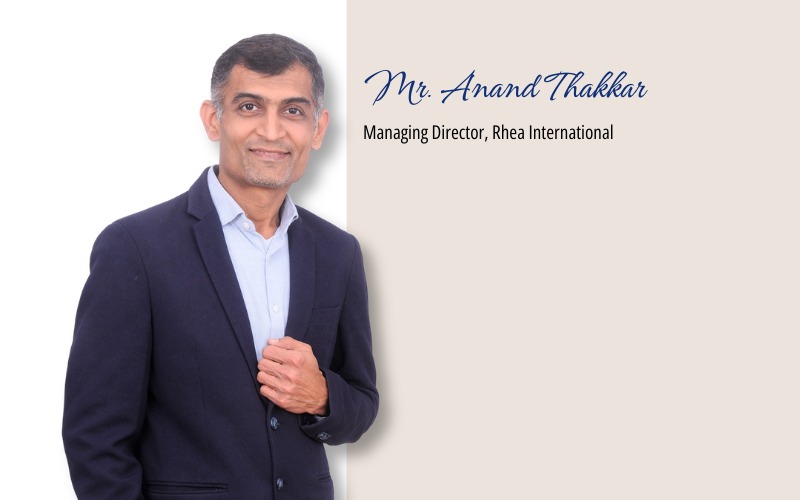
Interview with Mr. Anand Thakkar, Managing Director, Rhea International
Our mission is to generate sustainable job opportunities in the handicrafts sector while empowering local artisans by connecting them to global export markets. Through promoting traditional craftsmanship on an international platform, we aim to strengthen rural livelihoods and contribute to the nation’s economic growth as responsible economic soldiers.
TexMart : What was the founding vision behind Rhea International in the textile and fashion accessory sourcing space, and how has it shaped your business philosophy today?
Anand Thakkar : The founding vision behind Rhea International was very clear from the beginning. The idea was to work as an economic soldier for our country. We wanted to support India’s textile and fashion export industry by making sourcing simple, reliable, and professional for global buyers.
Our main objective is to provide world class service to our clients. We want to ensure that our customers do not waste their valuable time searching for the right supplier for value added trims, laces, fabrics, fashion accessories and toys. We take complete responsibility for identifying the correct manufacturer, checking quality, and ensuring compliance. This vision has influenced our business philosophy even today. We believe in responsibility, discipline, trust, and long-term value creation for both buyers and suppliers.
TM : Can you share the core inspiration that drives your team when selecting trims, fabrics, and accessories for global clients?
AT : The core inspiration that drives our team is a strong belief in “Function First” design. We always select trims, fabrics, laces ,accessories and toys that improve the wearer’s experience. For example, we focus on easy-care trims that increase the life of a garment and reduce maintenance issues for the end user.
Another important inspiration is cultural fusion and heritage. We regularly draw ideas from traditional and artisanal techniques, especially Indian handiwork. These elements add uniqueness and authenticity to modern garments while still meeting global quality expectations.
We also see value-added trims as an important part of brand identity. Small details like badges, patches , flowers, embroidery, sequins , stickers or appliqués help a brand stand out in a crowded market. Our team works to ensure that every accessory adds meaning, visual appeal, and practical use to the final product. Our aim is to balance aesthetic beauty with performance so that every component serves a clear purpose.
TM : From an R&D standpoint, how does historical industry insight influence your product innovation roadmap?
AT : From an R&D point of view, our long industry experience plays a major role in guiding innovation. Our team has more than 28 years of combined learning in apparel manufacturing and sourcing. This experience has helped us understand what works well and what fails over time.
Because of this background, we are able to guide customers with confidence and offer full partnership throughout the sourcing process. Our manufacturers have proven track records, which reduces risk for buyers. With our presence in multiple countries, our network closely observes global trends, customer expectations, and upcoming market movements. This historical knowledge allows us to plan products that are relevant, reliable, and future-ready.
TM : How do you ensure that your range of trims, zippers, and embroidered appliqués meets evolving textile quality and compliance standards?
AT : We follow a structured and detailed process to ensure that our products meet global quality and compliance standards.
First, we focus on strict raw material sourcing. We work only with suppliers who provide proper certifications such as Oeko-Tex Standard for harmful substances and GRS for recycled materials. All metal trims, zippers, and dyes are checked for compliance with REACH regulations in Europe and CPSIA regulations in the USA. We also ensure ethical sourcing by partnering with factories that follow fair labour practices and safe working conditions.
Second, we conduct rigorous in-house testing. Buttons and snaps go through pull tests to ensure safety, especially for children’s wear. Embroidered appliqués are tested for thread strength, colour bleeding, and secure backing. All metal accessories pass through needle detector machines to avoid contamination. Nickel release testing is done to prevent skin allergies.
Finally, post-production audits are carried out. Finished garments are randomly checked using AQL sampling. We verify trim functionality, colour consistency, and correct placement. Third-party lab testing is done for colour fastness, shrinkage, and seam strength. Detailed documentation is maintained for full traceability and transparency.
TM : Can you detail any proprietary or emerging technologies you use in textile product development or material selection?
AT : While we focus strongly on fundamentals, we also adopt practical technologies that improve speed and accuracy. Our development process includes physical prototyping supported by digital communication. This helps reduce errors and speeds up approvals. Our strength lies in combining hands-on experience with simple but effective tools that clients can easily understand and trust.
TM : From an R&D perspective, what new material technologies are you currently exploring to enhance performance or sustainability?
AT : From an R&D perspective, we are actively exploring new material options that support sustainability. One key area of focus is the development of crochet yarns made using natural dyes. These dyes do not contain harmful chemicals and are designed to have good colour fastness. This helps meet environmental standards while still delivering durable and attractive products.
TM : How do you identify and respond to shifts in global textile and fashion trends when sourcing products for clients?
AT : To identify changes in global fashion and textile trends, we use both digital research and physical market exposure. We subscribe to professional trend forecasting platforms that provide information on colour palettes, textures, and lifestyle changes 12 months in advance.
We also attend major trade shows and fabric fairs across the globe. These events help us understand new sustainable materials, innovative fabrics, and evolving manufacturing methods. Direct interaction with global suppliers and designers helps us respond quickly to market shifts.
TM : What market insights have driven your most successful product innovations in trims, accessories, or apparel components?
AT : One of the strongest market insights has been the growing demand for sustainable products. This has led us to work with recycled materials such as buttons and threads made from rPET (made from recycled PET bottles), and accessories from other recycled metals. These products meet both environmental goals and buyer expectations.
TM : From an R&D and market standpoint, how do you forecast emerging needs in technical textiles or specialty fabrics?
AT : We forecast emerging needs by closely observing buyer feedback, compliance updates, and performance requirements. Many buyers now look for durability, safety, and sustainability together. Our R&D planning reflects this by selecting materials that perform well under usage while meeting environmental and safety norms.
TM : What business strategies have helped Rhea International build long term relationships with textile manufacturers and global buyers?
AT : Rhea International focuses strongly on long-term relationships rather than short-term transactions. Our main strategy is to place the customer at the centre of every decision. We take time to understand the buyer’s product category, target market, price sensitivity, and compliance requirements before suggesting any supplier or material.
For example, if a buyer is supplying garments to Europe, we ensure that trims and accessories meet European safety and chemical rules from the beginning. This reduces rework and delays. We also customise trims and accessories based on brand positioning. A mass-market brand and a premium fashion label require very different finishes even if the garment looks similar.
On the supplier side, we work only with factories that are willing to grow with us. We maintain regular communication, share buyer feedback, and support them in improving quality and documentation. This transparent working style builds trust and ensures repeat business from both buyers and manufacturers.
TM : How do you balance cost efficiency with quality assurance across different sourcing regions like India, China, and Bangladesh?
AT : Sourcing from regions like India, China, and Bangladesh requires careful balance between cost and quality. We start by setting clear quality standards before placing any order. These standards include material specifications, tolerance levels, compliance needs, and packing instructions.
Cost savings are achieved by long-term planning rather than compromising quality. By placing repeat orders with trusted suppliers, we are able to negotiate better prices while maintaining consistency. We also explain cost-quality trade-offs clearly to buyers. If a lower-cost option affects durability or appearance, we communicate this openly. This honesty helps buyers make informed decisions and avoids disputes later.
TM : From an R&D and operations perspective, how do you integrate feedback loops to improve product lifecycle and delivery performance?
AT : Feedback plays a key role in improving our product lifecycle and delivery performance. After every sampling stage, we collect comments from buyers related to look, feel, performance and usability.
For example, if a buyer reports that an embroidered patch feels stiff after washing, we adjust backing material or stitch density. Post-delivery feedback is also reviewed to understand packing damage, colour variation, or handling issues. Over time, this continuous feedback process helps reduce errors, shorten development cycles, and improve overall satisfaction.
TM : What recent technological advancements such as digital sampling or CAD tools have you integrated into your textile product development processes?
AT : Technology supports our product development mainly through faster communication and visual clarity. We create physical samples and share high-quality images and videos with buyers using email and messaging platforms. This allows buyers to review products without waiting for courier samples in early stages.
If a buyer requests a change such as colour adjustment or size correction, the modification is done quickly and shared again. This process reduces development time and avoids repeated physical shipments. Though simple, this approach uses technology effectively to improve speed and accuracy.
TM : How is technology used in your quality testing and compliance systems before shipment?
AT : Technology is also used during quality checks and compliance verification. Before shipment, products are tested at the factory for strength, colour fastness, and safety. Test reports and inspection records are maintained digitally for easy access.
Once goods reach our warehouse, our internal quality team conducts a second-level inspection using structured checklists. Quantity verification and packaging checks are recorded systematically. This two-step inspection system reduces shipment errors and ensures buyer confidence.
TM : From a research and innovation view, do you foresee AI or machine learning playing a role in future fabric or trim design pipelines?
AT : Yes, from a research and innovation perspective, AI and machine learning (ML) are not just anticipated to play a role; they are rapidly becoming a foundational necessity in the future of fabric and trim design pipelines. The integration of these technologies is transitioning from pilot projects to core infrastructure, driven by the need for faster, more sustainable, and customized product development.
TM : What are your key growth priorities for the next 3–5 years in expanding textile product categories and services?
AT : We wish to develop a trims manufacturing unit in India with innovative products so that it will help exporters to add value of their products.
Over the next three to five years, Rhea International aims to move beyond trading into value creation. One key priority is to establish a trims manufacturing unit in India. This unit will focus on innovative trims that help garment exporters improve product appearance and perceived value.
By manufacturing locally, we can control quality better, reduce lead times, and support the Indian export ecosystem. This also helps buyers who prefer India-based sourcing for reliability and compliance reasons.
TM : How do you plan to leverage innovations in materials science to expand into technical or performance textiles?
AT : We plan to use advances in materials science to expand into performance-driven trims and accessories. Sustainable raw materials such as banana fibre from agricultural waste and recycled polyester from PET bottles are key focus areas. These materials can be used in threads, labels, and decorative trims that are strong, lightweight, and eco-friendly. Using such materials helps brands meet sustainability goals without sacrificing product quality.
TM : From an R&D ambition standpoint, how do you envision new sustainable fabrics or smart textiles shaping your future offerings?
AT : Sustainable and smart textiles are expected to change how garments are designed and used. In the future, trims may offer added features such as durability under repeated washing or better comfort for the wearer.
We see strong potential in fabrics and accessories that combine environmental responsibility with functional benefits. Our future product development will reflect this balance.
TM : How does Rhea International ensure ethical sourcing and compliance with labor, environmental, and safety standards across its supply chain?
AT : Ethical sourcing is a core responsibility at Rhea International. We source materials only from factories that follow labour laws, environmental rules, and safety guidelines. Our team regularly checks audit reports and factory certifications.