

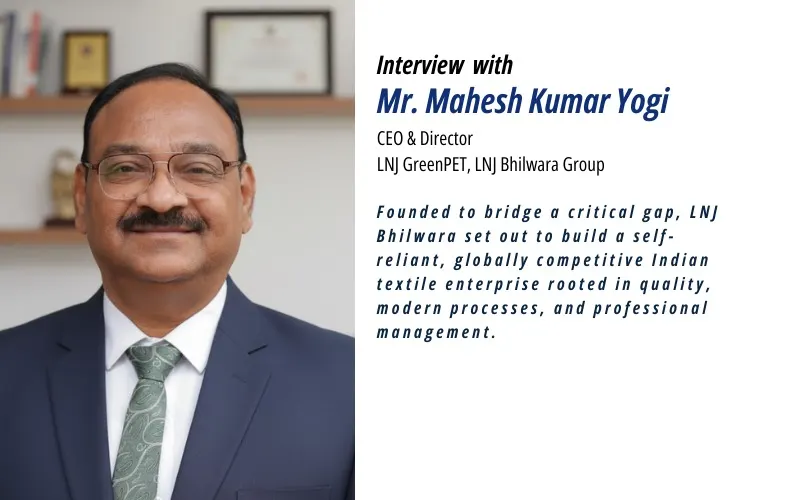
Interview with Mr. Mahesh Kumar Yogi, CEO & Director, LNJ GreenPET, LNJ Bhilwara Group
Founded to bridge a critical gap, LNJ Bhilwara set out to build a self-reliant, globally competitive Indian textile enterprise rooted in quality, modern processes, and professional management.
TexMart : LNJ Bhilwara began with a small textile mill in Bhilwara and grew into a diversified conglomerate what core mission and market gap inspired this foundational vision?
Mahesh Kumar Yogi : LNJ Bhilwara was founded with a clear mission to build a self-reliant, globally competitive Indian manufacturing enterprise at a time when the country depended heavily on imports and fragmented production systems. The initial textile mill in Bhilwara was not just a business venture, but a response to a critical market gap; India’s need for consistent quality manufacturing, modern processes, and professional management in a sector dominated by small , unorganized players. Mr. L. N. Jhunjhunwala believed that Indian industry could succeed globally by combining technology adoption, disciplined operations, and ethical business practices with long-term thinking. The focus was on creating scale, generating employment, and delivering reliable quality rather than chasing short-term profits. This mission of building value-driven, process-oriented businesses became the foundation for LNJ Bhilwara’s evolution into a diversified conglomerate across textiles, energy, advanced materials, and sustainable manufacturing.
TM : How has the group’s commitment to combining tradition with advanced textile practices shaped its identity in yarn, fiber, and recycled materials manufacturing?
MKY : As part of the LNJ Bhilwara Group, RSWM Limited embodies the group’s philosophy of blending strong textile heritage with advanced manufacturing excellence. RSWM’s long-standing expertise in yarn and fibre production has created deep technical understanding of raw materials, process discipline, and stringent quality benchmarks – especially at its Recycled Polyester Staple Fibre (RPSF) plant, which is widely recognized for producing high-quality, consistent recycled fibre. Building on this foundation, RSWM has continuously invested in modern machinery, automation, advanced testing laboratories, and global best practices. This has enabled the company to The RPSF plant, in particular, reflects this evolution by combining traditional fibre know-how with cutting-edge recycling and quality-control technologies. This balanced integration of heritage and innovation allows RSWM to deliver reliable, performance-driven fibres while meeting global expectations for sustainability, efficiency, and traceability. It is this approach that positions RSWM and the LNJ Bhilwara Group, strongly in future-ready, circular manufacturing sectors.
TM : From an R&D perspective, what early fiber or raw-material challenges during your initial years drove investments in technology and process improvements?
MKY : In our early years, variability in fiber quality and raw-material consistency was a key challenge. Differences in contamination levels, strength, and performance directly impacted process stability and end-product reliability. These challenges highlighted the need for stronger R&D involvement at the shop-floor level. As a result, we invested in advanced testing laboratories, improved filtration systems, and tighter process controls. Continuous experimentation and data-driven improvements helped us standardize inputs and reduce losses. These experiences now strongly influence LNJ GreenPet’s approach, where technology selection, raw-material qualification, and SOP design are planned rigorously from the start to handle recycled material complexities effectively.
TM : RSWM, the group’s flagship, produces synthetic, cotton, and blended spun yarns how do you ensure consistent performance and quality across such diverse fiber types?
MKY : At RSWM, consistency across synthetic, cotton, and blended yarns is achieved through strong process discipline and technology-led control systems. Each fiber type has dedicated SOPs, machine settings, and quality benchmarks, supported by advanced testing at every critical stage. Real-time monitoring, skilled operators, and regular calibration of equipment help minimize variation. In addition, feedback from downstream customers is closely integrated into process improvements. This structured approach ensures uniform performance, reliability, and global quality compliance across our diverse yarn portfolio.
TM : The group pioneered recycled polyester fibre (FibreGreen) from post-consumer PET bottles what were the key technical hurdles in developing and scaling this fiber conversion process?
MKY : Developing and scaling FibreGreen involved overcoming challenges related to consistent raw-material quality, contamination control, and achieving virgin-like fibre properties from post-consumer PET bottles. Variability in bottle waste required robust sorting, washing, and decontamination processes. Ensuring uniform IV, strength, and dyeability at scale was another key hurdle. These challenges were addressed through continuous R&D, advanced filtration, process optimization, and close monitoring at every stage, enabling reliable large-scale production that meets global quality and sustainability standards.
TM : With the upcoming LNJ GREENPET rPET resin facility, how are you integrating cutting-edge recycling technology to meet stringent food-grade quality standards for PET resin?
MKY : At LNJ GreenPet, the upcoming rPET resin facility is being designed from day one to meet the most stringent global food-grade standards. We are integrating advanced bottle-to-bottle recycling technologies, including multi-stage washing, high-efficiency decontamination, and precise solid-state polymerization processes to restore PET to near-virgin quality. Strong emphasis is being placed on traceability, in-line quality monitoring, and compliance with international food-contact regulations. By embedding these technologies at the project stage, we aim to ensure consistent quality, safety, and reliability once commercial operations begin.
TM : Given your global exports and multi-fiber product range, how does market feedback drive innovation in new fiber blends and specialty yarn offerings?
MKY : Although LNJ GreenPet is yet to commence commercial production, it benefits significantly from the LNJ Bhilwara Group’s strong global footprint and deep multi-fiber expertise. Continuous feedback from international customers and brand partners provides valuable insights into evolving expectations around performance, sustainability, traceability, and regulatory compliance. These learnings guide our R&D thinking well in advance. At LNJ GreenPet, this market intelligence is being embedded at the design and engineering stage itself. The facility is being developed to recycle post-consumer waste PET bottles into high-quality recycled PET (rPET) resin, which will further enable the production of recycled fibres from waste bottles. Process selection, quality benchmarks, and technology choices are all aligned with real market requirements rather than post-production corrections. In essence, global market feedback acts as a strategic compass, ensuring that when LNJ GreenPet begins operations, its recycled bottles-to-resin and fibre solutions are future-ready, globally compliant, and strongly aligned with circular economy principles.
TM : What emerging global trends in sustainable fibers and recycled PET are most influencing your product roadmap and investment priorities?
MKY : Several global trends are strongly shaping our product roadmap and investment priorities. Foremost is the rapid shift toward circular economy models, where brands increasingly demand traceable, recycled and low-carbon materials. Rising adoption of food-grade rPET for beverage and packaging applications is another key driver, pushing us to invest in advanced decontamination and purification technologies. Additionally, there is growing emphasis on compliance with global sustainability certifications and regulations. Together, these trends are guiding LNJ GreenPet to focus on high-purity rPET resin, scalable recycling infrastructure, and future-ready solutions aligned with long-term environmental and regulatory expectations.
TM : From an R&D lens, how do you identify and prioritize innovations such as enhanced recycled fibers, colorfastness improvements, or new fiber functionalities that meet future market demands?
MKY : From an R&D perspective, we prioritize innovations by closely tracking global brand requirements, regulatory developments, and evolving end-use applications. Market signals such as demand for higher recycled content, improved colorfastness, and functional performance are evaluated alongside technical feasibility and scalability. Pilot trials, lab validation, and benchmarking against global standards help us assess readiness before commercialization. We also focus on innovations that deliver measurable sustainability gains without compromising quality. This disciplined, demand-led approach ensures our R&D efforts remain aligned with future market needs and long-term value creation.
TM : How has RSWM’s business strategy adapted to balance traditional textile production with new sustainable fiber initiatives such as rPET and recycled polyester production?
MKY : RSWM’s strategy has evolved by strengthening its core textile businesses while progressively investing in sustainable fibre initiatives, with its RPSF (Recycled Polyester Staple Fibre) unit playing a dedicated and central role. The RPSF unit is exclusively focused on recycled fibre production, leveraging decades of manufacturing excellence, process discipline, and quality control developed through traditional yarn businesses. Rather than disrupting existing operations, sustainability has been integrated as a core growth pillar. RSWM uses its deep understanding of fibre behavior, consistency, and performance to scale high-quality recycled polyester in a structured manner. This approach is supported by phased investments, strong in-house R&D, advanced testing, and clear market-linked demand, ensuring continuity, balanced risk, and a smooth transition toward future-ready, circular textile solutions.
TM : What role does operational feedback from large spinning and fabric units play in refining process technology and product quality standards?
MKY : Operational feedback from our large spinning and fabric units is critical in fine-tuning both process technology and quality standards. Real-time production data, quality deviations, and operator insights help R&D and technical teams identify improvement areas early. This feedback loop enables faster process optimization, better raw-material selection, and consistent standardization across units, ensuring scalable quality and reliable performance across diverse products.
TM : As global sustainability standards evolve, how do you align strategic planning with technical investments in fiber innovation and recycling technologies?
MKY : We align our strategic planning closely with evolving global sustainability standards by tracking regulatory trends, brand protocols, and customer expectations well in advance. These insights guide our technical investments in fiber innovation, recycling technologies, and testing infrastructure. By integrating sustainability goals into capital planning and R&D priorities, we ensure that new technologies not only meet compliance requirements but also deliver long-term efficiency, traceability, and scalable environmental impact.
TM : How has technology in fiber production and recycling advanced in India particularly in converting PET bottles into commercial textile fibers over the last decade?
MKY : Over the last decade, fiber production and recycling technology in India has advanced significantly, especially in PET bottle–to–fiber conversion. The industry has moved from basic mechanical recycling to more controlled, high-precision processes involving advanced washing, decontamination, melt filtration, and online quality monitoring. These improvements have enabled better consistency, higher purity, and wider acceptance of recycled fibers by global brands. Investments in automation, testing, and traceability systems have helped Indian manufacturers produce recycled polyester that meets international performance, safety, and sustainability standards at scale.
TM : What role do automated quality-control systems and laboratory testing play in ensuring consistency across your wide range of yarn, fabric, and recycled fiber products?
MKY : Automated quality-control systems and advanced laboratory testing are critical to ensuring consistency across our yarn, fabric, and recycled fiber portfolio. Automation allows real-time monitoring of key parameters such as denier, tenacity, elongation, and contamination levels, helping us detect deviations early and maintain process stability. Well-equipped laboratories validate these results through physical, chemical, and performance testing against internal benchmarks and customer standards. Together, these systems ensure repeatability, traceability, and uniform quality across products, while also enabling continuous improvement and faster adoption of new materials and processes.
TM : What technology gaps still exist in India’s fiber and rPET manufacturing ecosystem, and how is RSWM addressing them through innovation and R&D collaborations?
MKY : Despite significant progress, gaps remain in India’s fibre and rPET ecosystem—particularly in feedstock consistency, advanced decontamination, energy-efficient processing, and end-to-end traceability. Many facilities still depend on conventional sorting systems and limited in-line quality monitoring, which can impact fibre purity, consistency, and downstream performance. At RSWM, the RPSF unit is dedicated exclusively to fibre development and production, and plays a key role in addressing these gaps. The unit focuses on process refinement, fibre consistency, and performance enhancement through targeted R&D, pilot-scale trials, and close collaboration with global technology partners. Investments in advanced filtration systems, automated quality controls, laboratory-backed testing, and process validation enable RSWM’s RPSF unit to produce high-quality recycled fibres that meet stringent international standards. This focused approach is strengthening India’s recycled fibre ecosystem and supporting scalable, future-ready circular textile solutions.
TM : With increasing global emphasis on sustainable textiles and circular economy, how do you see India’s fiber and recycled PET industry growing over the next 5–10 years?
MKY : India’s fiber and recycled PET industry is poised for rapid growth over the next 5–10 years, driven by regulatory mandates, rising brand commitments, and growing consumer awareness around sustainability. Demand for food-grade rPET, recycled fibers, and traceable circular materials is expected to increase sharply, creating opportunities for scale and technological innovation. Indian manufacturers, by adopting advanced processing, automation, and quality assurance systems, can transition from being primarily cost-competitive producers to globally recognized suppliers of high-performance, sustainable fibers. RSWM aims to be at the forefront of this transformation, setting benchmarks in quality, sustainability, and circularity.
TM : What role will advanced fiber technologies such as recycled PET, bio-based fibers, or functional blends play in shaping India’s competitiveness in global textile exports?
MKY : Advanced fiber technologies—including recycled PET, bio-based fibers, and functional blends—will be central to India’s competitiveness in global textile exports. These materials address the twin imperatives of sustainability and performance demanded by international brands and consumers. By producing high-quality, traceable, and functional fibers, India can differentiate itself from low-cost, low-value producers and access premium markets. Adoption of these technologies also drives process innovation, efficiency, and compliance with global environmental standards, positioning Indian manufacturers, including RSWM, as reliable partners for sustainable, next-generation textile solutions worldwide.
TM : From a technical and strategic viewpoint, how is your organization preparing to scale production capacity and capabilities in next-generation fiber technologies?
MKY : From both a technical and strategic perspective, we are preparing to scale next-generation fiber production through state-of-the-art plant design, advanced process automation, and robust quality-control systems. Pre-commercial pilot trials, process optimization, and R&D validation are being completed before full-scale operations to ensure consistency and compliance with international standards. Strategically, we are aligning infrastructure, workforce training, and supply-chain readiness to support scalable production. Investments in technology partnerships, sustainable practices, and traceability systems ensure that as demand grows, RSWM can expand capacity efficiently while maintaining high-quality, food-grade rPET and other advanced fiber solutions.
TM : The Polyester fiber recycling initiatives significantly reduce landfill waste how does LNJ Bhilwara measure and report its environmental impact and circularity outcomes?
MKY : At LNJ Bhilwara, we measure environmental impact and circularity through a combination of material recovery metrics, energy and water usage tracking, and waste reduction indicators. For polyester fiber recycling, we quantify the volume of post-consumer PET collected, processed, and converted into recycled fiber, directly reflecting landfill diversion. Sustainability reporting includes monitoring carbon footprint, water-efficiency improvements, and compliance with global standards such as GRS (Global Recycled Standard) and OEKO-TEX. These metrics are systematically recorded, audited, and communicated to stakeholders, ensuring transparency and demonstrating tangible contributions to circular economy objectives.
TM : What community or workforce skill development programs do you undertake to build capabilities in sustainable fiber manufacturing and advanced textile technologies?
MKY : LNJ Bhilwara invests significantly in workforce and community skill development to support sustainable fiber manufacturing and advanced textile technologies. We run training programs for machine operators, process engineers, and quality teams, focusing on automation, recycling processes, and quality standards. In parallel, community initiatives aim to upskill local youth and informal waste-collection workers, integrating them into the recycling ecosystem responsibly. Collaborations with technical institutes and R&D centers further enhance knowledge transfer, ensuring that both our employees and surrounding communities are prepared to contribute to high-quality, sustainable, and technologically advanced textile and recycled fiber production.
TM : How do you ensure responsible sourcing of raw materials and ethically compliant production practices across your fiber and textile operations?
MKY : We ensure responsible sourcing and ethical production through a combination of supplier audits, compliance standards, and internal governance systems. All raw-material suppliers are evaluated for environmental practices, labor compliance, and traceability of inputs. Within our operations, we implement strict SOPs, automated monitoring, and quality controls to maintain ethical and sustainable practices at every stage.