
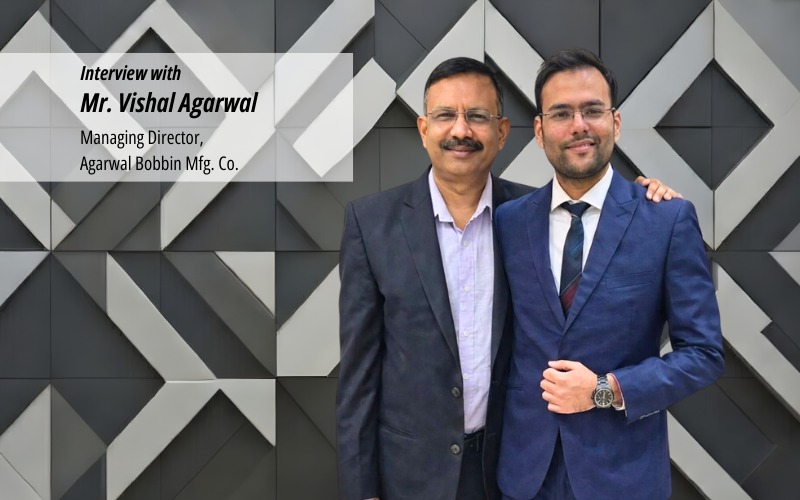
Interview with Mr. Vishal Agarwal, Managing Director, Agarwal Bobbin Mfg. Co.
Established in 1981 in New Delhi, Oswal Traders / Agarwal Bobbin Manufacturing Company is a leading manufacturer and supplier of Plastic and Textile Bobbins along with Textile Machinery Spares.
The company delivers high-quality, durable products using advanced technology and premium raw materials. Supported by modern infrastructure and an experienced team, it ensures efficient production, strict quality control, and timely delivery.
Texmart : What inspired the founding of Agarwal Bobbin and the decision to specialize in plastic bobbins for the textile industry?
Vishal Agarval : We identified a strong need for reliable and durable plastic bobbins in the textile sector. Many mills were facing frequent breakage and dimensional inconsistencies. Our vision was to specialize in precision plastic components that enhance machine efficiency. Quality and reliability became our foundation.
TM : How did your early interactions with textile mills and machine builders shape your vision for precision plastic components?
VA : Close engagement with mills and machine builders helped us understand operational challenges firsthand. We realized that even minor dimensional variations could impact yarn quality.
This shaped our focus on precision engineering and consistent performance. Customer feedback directly influenced our product standards.
TM : From an R&D perspective, what initial performance or durability challenges motivated you to develop your own line of bobbins and accessories?
VA : Durability issues, deformation under load, and material fatigue were common concerns. We invested in developing optimized plastic compounds and improved geometry designs. R&D became central to enhancing strength and lifespan. Performance-driven innovation guided our early growth.
TM : Plastic bobbins are fundamental to spinning and winding how do you ensure consistent dimensional accuracy and material performance in every product?
VA : We follow strict injection molding controls and calibrated tooling systems. Each batch undergoes dimensional inspection and material quality testing. Precision molds and standardized processes ensure uniformity. Consistency is maintained across high-volume production.
TM : What technological processes or quality systems (e.g., injection molding precision, CAD design, material testing) differentiate your products from competitors?
VA : Advanced CAD design, precision injection molding, and structured quality checks form our core processes. Material testing ensures strength and stability under high-speed operations. Continuous process optimization enhances product reliability. Engineering precision differentiates us in the market.
TM : From an R&D standpoint, how do you test and optimize new plastic compounds, bobbin wall thickness, and geometry to improve lifespan and performance?
VA : We conduct stress testing, load simulations, and performance trials under real mill conditions. Wall thickness and geometry are optimized for balance and durability. Material blends are refined for impact resistance and longevity. Testing ensures extended service life.
TM : With the textile industry demanding higher consistency and uptime, how do you capture and incorporate market feedback into your product innovations?
VA : Regular interaction with spinning and winding units helps us gather performance insights. Maintenance feedback guides design improvements. Product modifications are based on uptime and efficiency requirements. Continuous engagement drives innovation.
TM : How do you assess the needs of different textile subsectors (ring spinning, open end, winding, hosiery, etc.) to tailor bobbin designs?
VA : Each textile segment has unique speed, tension, and load requirements. We customize bobbin dimensions and material strength accordingly. Sector-specific design ensures compatibility and performance. Flexibility supports diverse applications.
TM : What innovative features such as reduced friction surfaces, color coding, or smart traceability tags is your R&D exploring for future bobbin generations?
VA : We are exploring enhanced surface finishes to reduce friction and wear. Color coding for better process identification is under development. Smart traceability integration is also being evaluated. Future-ready features enhance operational efficiency.
TM : Textile component supply can be highly price-sensitive how has your business strategy evolved to balance cost competitiveness with premium quality?
VA : We optimize production efficiency while maintaining premium material standards. Long-term durability reduces replacement frequency, offering better value. Strategic sourcing helps manage cost pressures. Quality remains non-negotiable.
TM : What operational learnings from working with mills and OEMs have most influenced your approach to customer service and delivery reliability?
VA : Timely delivery and consistent quality are critical for mills. We strengthened logistics planning and quality assurance systems accordingly. Responsive communication builds long-term trust. Service reliability complements product reliability.
TM : As textile machinery and processes modernize, how do you align strategic planning with investments in technology and product development?
VA : Timely delivery and consistent quality are critical for mills. We strengthened logistics planning and quality assurance systems accordingly. Responsive communication builds long-term trust. Service reliability complements product reliability.
TM : How have advancements in spinning, winding and automated yarn processing influenced requirements for precision plastic components like bobbins?
VA : Higher spindle speeds demand superior balance and material stability. Even slight deformation can affect yarn quality. Precision tolerance has become more critical. Our engineering evolves with machine advancements.
TM : What role do enhanced materials (engineering plastics, composites) and automated manufacturing play in elevating product quality?
VA : Engineering plastics and improved composites enhance durability and load capacity. Automated manufacturing ensures consistent dimensional control. Material innovation directly improves performance. Technology elevates overall product quality.
TM : From an R&D perspective, what gaps still exist in the Indian textile components ecosystem that need innovation or collaboration?
VA : Greater material innovation and standardized testing systems are needed. Collaboration between component makers and machine OEMs can be strengthened. Digital traceability in components is still limited. Innovation will drive ecosystem growth.
TM : With India’s textile sector pursuing higher value and exports, how do you see demand for advanced plastic components evolving over the next 5–10 years?
VA : As India focuses on higher-value textiles and exports, demand for precision components will rise. Automation and faster machines require advanced bobbins. Quality-driven manufacturing will define future demand. Growth opportunities are strong.
TM : What role will automation, IoT-enabled monitoring, and digital traceability play in future textile machine components like bobbins and carriers?
VA : Automation will require components with higher dimensional stability and traceability. IoT-enabled monitoring can improve lifecycle tracking. Digital integration will support predictive maintenance. Smart components represent the next phase.
TM : How is Agarwal Bobbin positioning itself strategically and technologically to support new machine platforms and smart factory environments?
VA : We are investing in advanced molding technologies and material research. Process automation and quality digitization are key focus areas. Strategic alignment with modern machinery trends guides development. We aim to support smart factory environments.
TM : Manufacturing plastic components can raise sustainability concerns how do you ensure responsible material selection, recycling and waste reduction in your processes?
VA : We focus on efficient material utilization and recycling practices. Waste reduction and responsible sourcing are integral to our process. Durable products also reduce frequent replacements. Sustainability is embedded in our operations.