
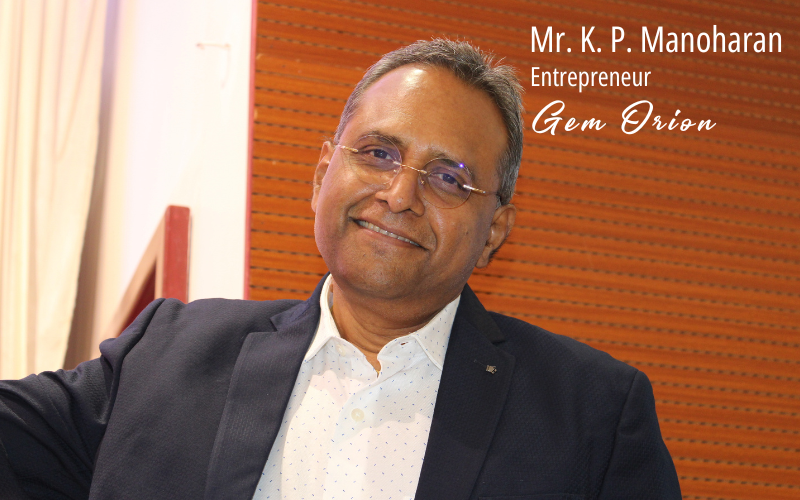
TexMart : What inspired the establishment of Gem Orion, and how has the company’s vision evolved since its inception?
K. P. Manoharan : Our Parent Company Gem Equipments was manufacturing Industrial Chillers since 1994. Gem also became a service provider for Orion Machinery Japan in 2007 to cater to the service requirements for its chillers supplied in India through OEMs. Gem’s Passion towards technological advancement and taking the product to the global level made the formation of Gem Orion, that was established as a joint venture between Gem Equipments of India and Orion Machinery of Japan in 2016, combining Indian manufacturing capabilities with Japanese technology. The company has evolved with a focus on reliable, energy-efficient and sustainable industrial cooling. Its vision continues to emphasize advanced technology and customer-oriented cooling solutions
TM : How does Gem Orion approach R&D to develop industrial chillers that deliver greater reliability and energy efficiency?
KPM : The complete design & technology was from Orion Machinery Japan. Gem Orion had to develop the product that suits Indian industry and proceed. We initially started with Precision Chiller (Non-Inverter chiller) with precise control of water temperature. Subsequently, Gem Orion R&D focuses on improving temperature control, energy consumption, reliability and operating performance. The company continuously upgrades its equipment and technologies to meet changing industrial requirements. Developments such as inverter-driven chillers demonstrate this focus on improving efficiency while maintaining precise cooling performance.
TM : What role does research play in adapting Japanese cooling technology to the specific requirements of Indian industries?
KPN : When Gem Orion went deep into the application and the requirement characteristics, able to understand the need for the Precise control of water temperature in each of the application. Some Customers who were looking for such solutions were identified and chillers supplied against a firm purchase order or on trials. Wherever we supplied & taken trials, the customers were thrilled by the performance and referred to many other customers. Market Research helps Gem Orion in understanding Indian operating conditions, ambient temperatures and application-specific cooling requirements. This enables Japanese technology to be adapted for local industrial environments. The result is equipment designed to deliver reliable performance while remaining practical and competitive for Indian customers.
TM : Gem Orion offers inverter, precision, dual-channel, EDM, coolant and industrial chillers; how do you determine the right technology for different applications?
KPN : The selection depends on the machine, heat load, required temperature, operating environment and process conditions. For example, inverter chillers are suitable where cooling loads fluctuate, while dual-channel systems address specific applications like Laser cutting / welding that requires separate temperature control. This application-based approach helps customers achieve reliable and efficient cooling.
TM : How is R&D helping Gem Orion improve the precision and energy efficiency of its next generation of chiller systems?
KPN : R&D is focused on variable-speed technology, improved heat-transfer performance, better controls and optimized system operation. Gem Orion’s inverter chillers can provide temperature control as low as ±0.1°C while adjusting cooling output according to actual demand. These developments help reduce unnecessary energy consumption and improve process stability. Gem Orion further extended the application band with reducing the minimum operating water/glycol mixture temperature to 0oC. Gem Orion focus on Air ccoled chillers that now becoming a mandate for many applications
TM : What research and engineering considerations go into developing dual-channel chillers for demanding applications such as laser cutting and welding?
KPN : The system must simultaneously manage different cooling requirements for the laser oscillator and optics. Orion Machinery is a Pioneet at Japan on this product. Initially the development was with single tank and 2 circuits like other manufacturers at that point of time. The Gem Orion decided to have the uniqueness in dual-channel technology with independent water circuits with precise temperature control, allowing both components to operate at their required temperatures. R&D therefore focuses on thermal stability, condensation prevention, reliability and energy efficiency. Gem Orion was also faster to develop the models for high power laser. As the market matures slowly, Gem Orion releasing products for high power laser. Now Chiller models are available for capacities required up to 40kW Fiber Laser.
TM : What major changes are you observing in customer expectations for industrial cooling solutions across Indian manufacturing sectors?
KPN : Customers increasingly expect precision, energy efficiency, reliability and lower operating costs rather than simply cooling capacity. They are also looking for compact systems, easier maintenance and longer equipment life. The growing adoption of automated manufacturing is further increasing demand for accurate and dependable temperature control.
TM : How does Gem Orion identify new R&D opportunities emerging from changing industrial processes and customer requirements?
KPN : Customer feedback, application challenges and changes in manufacturing technology provide important inputs for product development. The engineering team studies specific cooling requirements and operating conditions before developing suitable solutions. This approach allows Gem Orion to create application-specific systems for sectors such as plastics, laser processing, pharmaceuticals and precision machining.
TM : With industries moving toward smarter and more connected equipment, what innovations are you exploring to make chillers more intelligent?
KPN : Connected communication, remote monitoring and intelligent control are important areas for modern industrial cooling. Gem Orion’s inverter systems already incorporate features such as RS485 connectivity, remote operation and machine communication capabilities. Future developments can further integrate cooling equipment with smart factory and predictive maintenance systems.
TM : How does Gem Orion balance technological advancement with cost competitiveness when serving the Indian industrial market?
KPN : The company combines Japanese technology with local manufacturing capabilities to provide advanced cooling solutions at competitive prices. Local production also supports faster service, availability and application-specific customization. This approach enables customers to access sophisticated cooling technology without depending entirely on imported systems.
TM : How has Gem Orion’s experience across different industrial applications influenced its product development strategy?
KPN : Experience across plastics, laser processing, Printing & packaging, medical equipment, CNC machining and other industries has exposed the company to diverse cooling requirements. These experiences help engineers understand different thermal loads and operating conditions. The knowledge gained from these applications supports continuous improvement and development of specialized products.
TM : What R&D capabilities are most important for maintaining a competitive advantage as industrial cooling technology becomes more advanced?
KPN : Strong thermal engineering, refrigeration expertise, controls development and product testing are essential. Gem Orion maintains product testing facilities and conducts performance evaluations under different operating and load conditions. Continuous engineering improvement helps the company maintain reliability while developing more efficient products.
TM : How is the adoption of automation, robotics and precision manufacturing changing the demand for industrial cooling systems in India?
KPN : Modern machines operate at higher speeds and tighter tolerances, making thermal stability increasingly important. Excessive temperature variation can affect machine accuracy, product quality and equipment life. Consequently, precision cooling systems are becoming an important part of automated and high-performance manufacturing environments.
TM : What R&D advancements are needed in India to develop more energy-efficient industrial cooling technologies for modern manufacturing?
KPN : Research should focus on variable-speed compressors, intelligent controls, efficient heat exchangers and optimized refrigeration systems. Developing systems that respond to real-time heat loads can reduce unnecessary power consumption. Further improvements in monitoring and automation can also help industries achieve better energy management.
TM : How can Indian chiller manufacturers contribute to reducing dependence on imported industrial cooling equipment through technology development?
KPN : Indian manufacturers can invest in engineering, testing facilities and application-specific product development.Technologies such as precision inverter chillers demonstrate how advanced systems can be developed and manufactured domestically. Strong R&D combined with quality manufacturing can help Indian products compete with imported solutions.
TM : Which industries do you believe will create the strongest demand for advanced industrial cooling systems in India over the next few years?
KPN : Electronics, semiconductors, electric vehicles, pharmaceuticals, plastics, medical equipment and advanced manufacturing are expected to require increasingly precise cooling. These industries rely heavily on process stability and controlled temperatures. The expansion of data centers and other technology-intensive facilities may also create new opportunities.
TM : What future R&D areas could significantly improve the efficiency and sustainability of industrial chillers in India?
KPN : Future research can focus on high-efficiency compressors, intelligent variable-speed systems, advanced heat exchangers and environmentally preferable refrigerant technologies. Digital monitoring can further optimize performance according to real-time loads. These improvements can reduce energy consumption and support more sustainable manufacturing.
TM : How do you see smart manufacturing and Industry 4.0 influencing the next generation of industrial chillers?
KPN : Industrial chillers are likely to become increasingly connected to factory automation systems. Real-time monitoring, remote diagnostics and predictive maintenance can help identify performance issues before they cause downtime. Integration with production data can also allow cooling systems to automatically adjust to changing process requirements.
TM : How does Gem Orion incorporate environmental sustainability into the design and operation of its industrial cooling solutions?
KPN : Energy efficiency is an important part of the company’s product philosophy. Technologies such as inverter-driven compressors adjust cooling capacity according to actual requirements, helping reduce unnecessary energy consumption. The company also emphasizes sustainable and efficient cooling solutions as part of its mission.
TM: What R&D initiatives can help the industrial cooling sector reduce its environmental impact while maintaining high performance?
KPN : Research into energy-efficient refrigeration cycles, advanced compressors and lower-impact refrigerants can reduce environmental impact. Better controls can also prevent overcooling and unnecessary power consumption. Combining these technologies with lifecycle-oriented product design can improve both sustainability and operating efficiency.
TM : How can manufacturers and technology providers work together to promote more responsible energy consumption in industrial operations?
KPN : Manufacturers can share actual operating data and energy requirements with technology providers. Chiller suppliers can then optimize equipment selection, capacity and control strategies for each application. Regular maintenance and performance monitoring can further ensure that equipment continues operating efficiently throughout its service life.
TM : How does participation in industry events and technical forums help Gem Orion understand emerging cooling technologies and customer expectations?
KPN : Industry events provide opportunities to interact directly with manufacturers, technology providers and customers. They help the company understand emerging technologies and identify changing application requirements. Such interactions can contribute valuable inputs for product improvement and future R&D initiatives.
TM : What role do customer feedback, industry recognition and technical achievements play in shaping Gem Orion’s future product development?
KPN : Customer feedback provides practical information about product performance and application challenges. Technical achievements and industry recognition can validate the company’s engineering capabilities and encourage further innovation. Together, these inputs help Gem Orion identify areas where future products can deliver greater value.
TM : Looking ahead, what major technological milestone or product innovation would you like Gem Orion to achieve in the coming years?
KPN : A key objective would be to develop increasingly intelligent, energy-efficient and highly precise cooling systems for advanced manufacturing. Future products could combine variable-speed technology, connected monitoring and predictive maintenance capabilities. Such developments would strengthen Gem Orion’s position in India’s rapidly evolving industrial cooling market.