


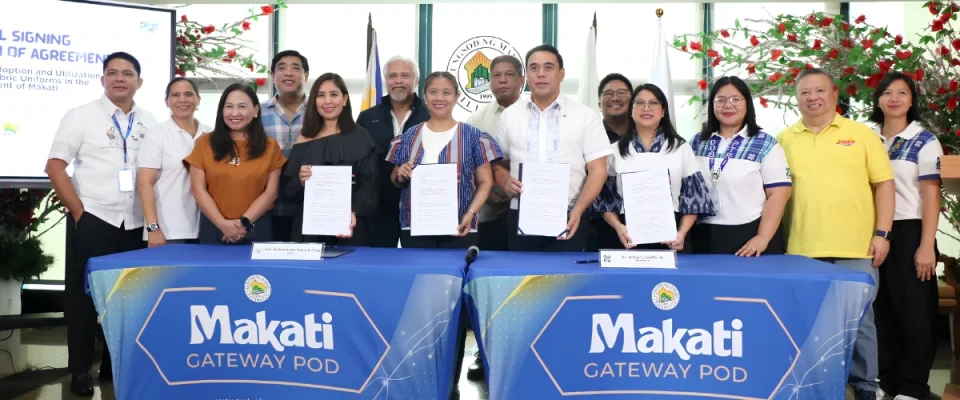
Makati becomes the first local government partner of DOST-PTRI to adopt Philippine tropical fabric uniforms, supporting Filipino farmers, weavers and the local textile industry.
Makati Mayor Nancy Binay today said the city government is integrating locally sourced textile materials into government operations, giving employees uniforms that showcase Filipino craftsmanship while supporting the growth of the local textile industry.
Binay on Tuesday signed an agreement that has made Makati the first-ever local government partner of the Department of Science and Technology – Philippine Textile Research Institute (DOST-PTRI) for the Performance Evaluation, Adoption, and Utilization of Philippine Tropical Fabric Uniforms.
Binay said the initiative reflects a personal commitment, as the project starts on an advocacy that began during her time in the Senate and has now come full circle through the City Government of Makati.
“This initiative is close to my heart because it is not simply about providing uniforms for our employees. It is about honoring Filipino craftsmanship, supporting our local farmers and weavers, and creating greater opportunities for our local textile industry,” Mayor Nancy said.
For Makati, the uniforms represent more than a change in fabric. They demonstrate how a government institution can use its purchasing power to support local industries and encourage the wider adoption of Filipino-made materials.
The City Government of Makati’s office wear contains 7.4% pineapple fiber, exceeding the minimum requirement under the Republic Act No. 9242 for Philippine tropical fabrics, which must contain at least 5% by weight of abaca, banana, or pineapple leaf fibers, or at least 15% Philippine silk.
A total of seven designs were developed for the City Government, featuring a poly-piña fiber base complemented by handwoven textile accents that seamlessly blend contemporary design with Filipino craftsmanship.
The women’s garments were sewn by Bayo Manila, while the men’s garments were produced by La Marina Philippines, a Makati-based garment manufacturer.
DOST-PTRI Director Dr. Julius L. Leaño, Jr. likewise emphasized the broader impact of using Philippine tropical fabrics: “Pagtuunan natin ng pansin ang Philippine tropical fabric.
“Hindi lang po ito compliance sa batas; nakatutulong din po ito sa ating mga magsasaka at mga naghahabi upang mas mapasigla ang industriya ng telang Pinoy.”
Through the partnership, Makati is demonstrating that compliance can become a catalyst for meaningful action—connecting government procurement with local production, livelihood generation, and the preservation of Filipino craftsmanship.