
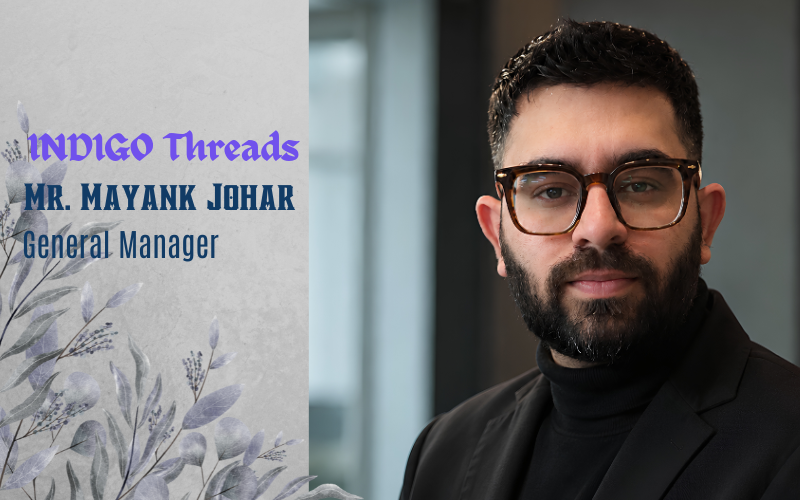
Indigo is a specialist dyeing and finishing partner for polyester sewing and embroidery threads. We work with manufacturers across apparel, home textiles, leather goods and embroidery to deliver threads that match their exact specifications – in colour, performance and reliability.
Texmart : What are INDIGO’s key products and specialty offerings?
Mayank Johar : Our portfolio includes spun polyester sewing threads, core-spun threads, recycled polyester threads and embroidery threads, manufactured across multiple constructions and specifications for apparel, home textiles and other sewn-product applications.
Colour development is one of our core strengths. INDIGO maintains more than 640+ ready shades and 65,000+ developed colours, giving us the ability to respond quickly and accurately to diverse customer and buyer requirements.
Sustainability is also becoming an increasingly important part of our product portfolio. We manufacture GRS-certified recycled polyester threads using post-consumer recycled material, providing customers with a more sustainable alternative without losing sight of the performance and consistency required in industrial sewing applications. Our approach is to offer more than a catalogue of standard threads. We aim to provide the flexibility to develop the right construction, shade and performance characteristics for the customer’s application.
TM : What differentiates INDIGO’s product and manufacturing capabilities?
MJ : What differentiates INDIGO is the combination of technology, speed, consistency and end-to-end process control within a flexible manufacturing setup.
A high level of automation across our operations reduces process variation and enables greater precision, repeatability and production efficiency. Our systems are structured for a rapid transition from DTM and shade development to bulk production, allowing us to respond quickly to the shorter development and production cycles increasingly demanded by the industry.
Quality is managed through a multi-tier QC system, with controls incorporated at critical stages from incoming material and dyeing to winding and final inspection. This approach allows potential deviations to be identified during the process rather than only at the finished-product stage.
Another significant strength is end-to-end traceability. Our systems provide highly granular, gram-level tracking of production and material movement through to the respective customer, strengthening accountability, consistency and root-cause analysis.
Our manufacturing is governed by standardised SOPs, documented processes and internationally aligned certification and compliance frameworks, helping us meet the increasingly stringent requirements of global textile supply chains.
Beyond these systems, colour capability and manufacturing flexibility remain important strengths. With over 640+ ready shades and 65,000+ developed shades, we can address diverse customer requirements while maintaining rapid development capabilities.
Our manufacturing setup also allows us to handle different thread constructions, specifications and order requirements without losing the responsiveness of a specialised thread manufacturer. We are progressively integrating automation, sustainability and resource efficiency into the same manufacturing framework.
Recycled product development, cleaner process energy, responsible chemical management and improved environmental controls are being developed alongside capacity expansion rather than as standalone initiatives. Ultimately, our objective is not simply to produce at scale. It is to deliver repeatable quality, complete traceability and rapid customer response at scale, while continuously improving the technology and processes behind the product.
TM : How are changing customer requirements influencing INDIGO’s strategy?
MJ : The definition of a good textile supplier has changed considerably. Customers today expect quality, speed, traceability, sustainability, compliance and competitive pricing simultaneously.
Shorter fashion and development cycles have increased the importance of rapid shade development and flexible manufacturing. At the same time, sustainability commitments are creating greater demand for recycled materials, responsible chemical management and measurable environmental performance.
We consider these changing requirements an important source of direction for our business. Rather than treating new customer or buyer requirements simply as compliance obligations, we try to understand what they indicate about the future of the industry and prepare our manufacturing systems accordingly.
For us, innovation does not always mean inventing an entirely new product. It can also mean solving an existing manufacturing problem faster, more consistently or more sustainably.
Our extensive shade database, rapid DTM-to-bulk capability, traceability systems, recycled product portfolio and increasing automation have all developed from this philosophy.
TM : What has contributed most to INDIGO’s growth and long-term customer relationships?
MJ : In B2B manufacturing, trust is ultimately built through consistency and reliability.
A customer remembers whether the shade was correct, whether the thread performed consistently on the production floor and whether the supplier delivered when promised. For this reason, we place as much importance on execution after receiving an order as we do on securing the order itself.
We have consciously focused on building long-term relationships rather than pursuing volume alone. As customer requirements have grown, we have continued reinvesting in manufacturing capability, technology, capacity and process control. One of the most important lessons from our experience has been that sustainable growth requires systems.
As manufacturing volumes increase, a business cannot remain dependent solely on individual experience. Processes have to become measurable, repeatable and documented. Quality systems, SOPs, technology, traceability, data and a capable team become increasingly important.
Our strategy therefore is to retain the speed and flexibility of a specialised manufacturer while developing the systems and capabilities expected from a much larger organisation.
TM : How do you see technology transforming Indian textile manufacturing?
MJ : Indian textile manufacturing is entering a period where automation and digitalisation will increasingly determine global competitiveness. Automation, advanced machinery, digital process monitoring, data-based quality control, traceability and resource-efficient manufacturing are already changing how textile factories operate.
In thread manufacturing specifically, automation can improve winding consistency, length accuracy, process repeatability, machine utilisation and production monitoring while simultaneously reducing variation and wastage. However, we believe smart manufacturing goes much further than installing automated machinery. The modern manufacturer needs to understand production, quality, energy, water, chemicals, wastage and environmental performance through measurable data. Once these parameters are measured accurately, they can be analysed and systematically improved.
TM : How is INDIGO approaching sustainable manufacturing?
MJ : We want sustainability to become an integral part of the manufacturing system rather than remain a separate initiative or certification exercise. Our GRS-certified post-consumer recycled polyester thread is one part of this approach. At the manufacturing level, our focus is increasingly on reducing energy intensity, improving resource efficiency and strengthening our environmental infrastructure.
We have introduced a PNG connection for process energy as part of our transition away from electricity-intensive heating systems and LPG dependence. Renewable electricity procurement is also being incorporated into our decarbonisation roadmap.
Water and effluent management are another major focus. We are strengthening our effluent-treatment and water-management infrastructure, with the longer-term objective of progressing towards Zero Liquid Discharge (ZLD).
Responsible chemical management, improved monitoring and alignment with international customer and buyer requirements are equally important components of this programme.
As production expands, our objective is not merely to reduce absolute environmental impact wherever possible, but to continuously reduce the environmental footprint per unit of production.
We believe the next generation of textile manufacturing has to demonstrate that growth, competitiveness and environmental responsibility can progress together.
TM : What role do employees and the wider textile ecosystem play in INDIGO’s growth?
MJ : Technology may improve manufacturing, but manufacturing quality ultimately depends on people.
As our operations become more automated and technologically advanced, we want our employees to develop alongside them through practical training, stronger process knowledge and greater exposure to modern machinery, quality systems and manufacturing practices.
Automation should not simply replace manual processes. It should allow people to move towards more skilled, technical and value-adding roles. We also see Indian manufacturing as an interconnected ecosystem rather than an isolated factory. Growth in domestic manufacturing creates opportunities for raw-material suppliers, machinery manufacturers, technical service providers, logistics companies and skilled workers.
Building a stronger Indian textile manufacturing base therefore creates value considerably beyond the boundaries of an individual company.
TM : What recent achievements have been particularly significant for INDIGO?
MJ : Being selected among the Top 7 finalists at the ET MSME Awards 2025 in our category was an important recognition for us. For a growing manufacturing business, recognition at a national MSME platform was encouraging because it reflected the progress we have made in scaling our operations while continuing to invest in quality, technology and sustainability.
At the same time, some of our most meaningful achievements are not represented by trophies. The confidence placed in our products by established garment and home-textile manufacturers, and our participation through them in supply chains serving major international brands, are important validations of the systems and capabilities we have built. Industry exhibitions and trade events also remain valuable to us. Beyond generating business, they provide direct exposure to new technologies, changing customer expectations, recycled materials, machinery developments and sustainability trends that can influence our future investment decisions.
TM : What can the industry expect next from INDIGO?
MJ : The next phase of INDIGO will be defined by scale, backward integration, automation and sustainability. We are working towards significantly expanding our production capability by 2027, while bringing greater control over critical manufacturing processes in-house through backward integration.
At the same time, we intend to continue increasing automation across manufacturing and strengthening the digital systems behind quality control, production monitoring and traceability. Importantly, this expansion is being planned alongside our environmental roadmap. Cleaner process energy, renewable electricity, improved water management, stronger effluent-treatment infrastructure and progress towards ZLD will form part of the same growth programme. Our ambition is not simply to manufacture more thread.
We want to build INDIGO into a technologically advanced, highly responsive and responsible Indian thread brand capable of competing with the best manufacturers globally.