


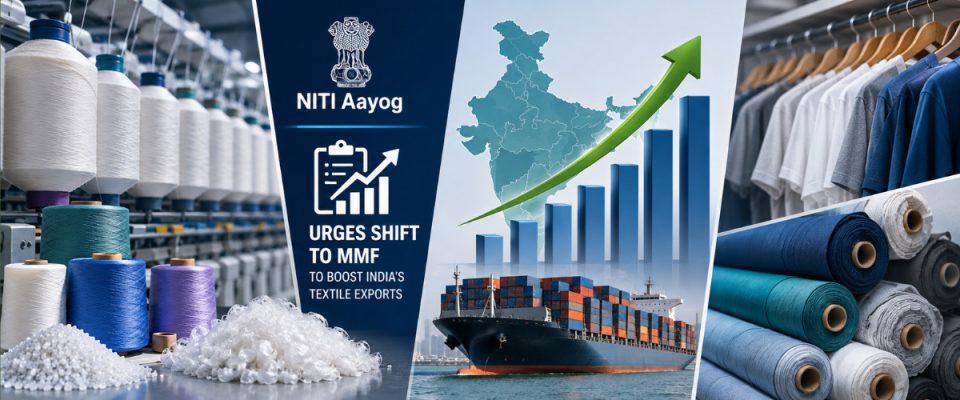
NITI Aayog highlights man-made fibres and technical textiles as key growth areas for India to strengthen its global textile and apparel export competitiveness.
India is being urged to accelerate its shift toward man-made fibre (MMF) textiles as the country seeks to strengthen its position in the global textile and apparel export market. NITI Aayog has highlighted the need to move beyond India’s traditional strength in cotton and expand value-added production across MMF fabrics, garments and technical textiles.
NITI Aayog’s assessment points to a structural change in global textile demand, with international markets increasingly moving toward man-made and blended fibres. India has a strong raw-material base but has historically remained more competitive in cotton yarn than in higher-value fabrics and finished textile products.
The shift toward MMF could create opportunities for manufacturers producing polyester, viscose, nylon and blended fabrics, particularly for applications where performance, durability, lightweight construction and design flexibility are important. Expanding these capabilities would allow Indian companies to participate more extensively in global value chains.
Technical textiles represent another major opportunity. These engineered textile products are used across automotive, construction, agriculture, healthcare, industrial safety, transportation and other sectors, offering Indian manufacturers opportunities to diversify beyond conventional apparel.
Government policy is already supporting the transition. India’s Production Linked Incentive (PLI) Scheme for Textiles is focused specifically on MMF apparel, MMF fabrics and technical textiles, with amendments intended to encourage wider participation, including from MSMEs.
The move is particularly important for India’s export competitiveness. NITI Aayog has noted that while India has a substantial textile value chain, it has not captured enough value in downstream fabric and garment manufacturing compared with major competing countries. Strengthening MMF capabilities could help India move further up the value chain.
For textile manufacturers, the transition will require greater investment in advanced spinning, weaving, knitting, dyeing, finishing and garmenting technologies, along with stronger product development capabilities. Sustainability and recycling will also become increasingly important as global buyers demand traceable and environmentally responsible textile products.
The proposed shift toward MMF therefore represents more than a change in fibre preference. It is part of a broader strategy to build a higher-value, diversified and globally competitive Indian textile industry, with MMF and technical textiles playing a larger role in future export growth.