


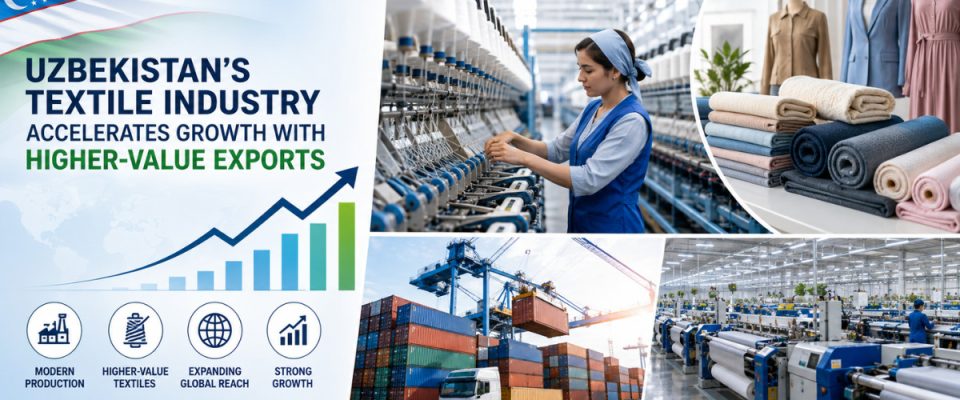
Rising production, investment and finished-goods exports are strengthening Uzbekistan’s textile sector as the country moves deeper into value-added manufacturing.
Uzbekistan’s textile industry is recording strong growth, supported by rising exports, increased investment and a strategic shift toward higher-value finished textile products. The sector is moving beyond its traditional focus on cotton and yarn to strengthen domestic processing and expand its presence in international apparel and textile markets. Official figures show textile exports reached US$2.6 billion in 2025, while exports of finished textile products increased 18.5% compared with 2024.
The industry exported products to 75 countries in 2025, with major destinations including Russia, Türkiye, Belarus, Kyrgyzstan, Kazakhstan, China, Germany and the UAE. Uzbekistan also entered new markets including Algeria, Angola, Greece and Kuwait, expanding opportunities for finished garments, knitted fabrics and woven textiles.
The expansion is being supported by a growing base of exporting companies. The number of textile-exporting enterprises reached 1,409, including 502 new exporters that generated US$203 million in shipments. This indicates a widening participation of domestic businesses in international textile supply chains.
Uzbekistan is also focusing on moving further up the value chain. Government plans for 2026 include deeper processing of cotton fibre and greater production of fabrics, knitwear and finished garments. The country has set a target of US$4 billion in textile exports in 2026, including US$700 million through e-commerce channels.
Investment is another major growth driver. In 2025, the textile industry attracted around US$2.1 billion in foreign investment, while 2026 plans call for approximately US$2.2 billion more. Planned capacity additions include synthetic and blended yarn, fabrics, garment and knitwear products, as well as textile dyeing facilities.
Recent trade data shows that momentum has continued into 2026. During January–May 2026, Uzbekistan’s textile exports reached US$1.268 billion, up 20.1% from the same period of 2025. Finished textile products accounted for about 50.8% of exports, while yarn represented 32.3%, highlighting the industry’s increasing emphasis on value-added manufacturing.
This transition is also reflected in the growing production of finished garments. Official data cited by Uzbekistan’s government indicates that finished garment output increased 24.3% in 2025, while the industry is increasingly incorporating higher-value materials such as linen, silk and viscose alongside its established cotton base.
For the textile industry, Uzbekistan’s strategy is increasingly centred on deep processing, synthetic and blended fibres, finished apparel and international supply-chain integration. New policy measures introduced in 2026 are intended to improve the financial stability of cotton-textile enterprises, encourage deeper processing and increase the sector’s export competitiveness.
The country’s textile expansion therefore represents more than higher production volumes. Uzbekistan is attempting to transform its cotton advantage into a broader value-added textile and apparel manufacturing ecosystem, potentially strengthening its position as a competitive sourcing base for international textile buyers.