


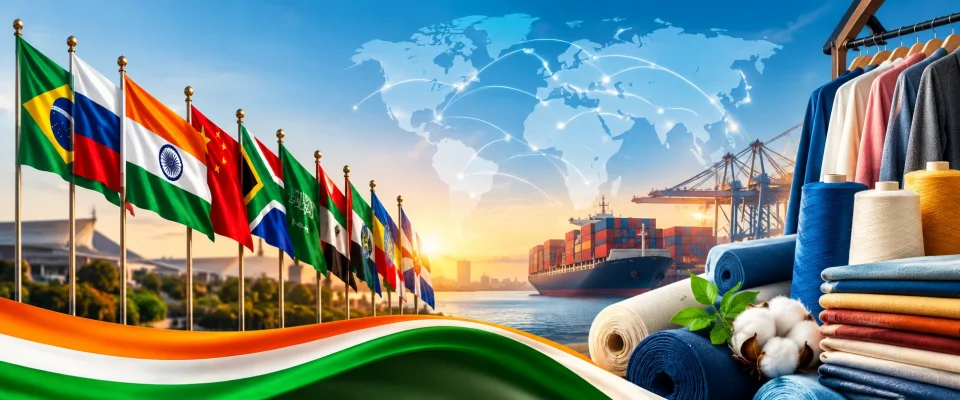
18th BRICS Summit Strengthens Prospects for India’s Textile and Apparel Exports
The 18th BRICS Summit, held in New Delhi on September 12–13, 2026, has opened new opportunities for India to strengthen exports, attract investment, expand technology partnerships and build more resilient global supply chains, with the textile and apparel sector emerging as one of the industries that could benefit from deeper economic cooperation among BRICS nations and the wider Global South.
Held under India’s presidency with the theme “Building for Resilience, Innovation, Cooperation and Sustainability,” the summit highlighted the growing role of BRICS as a platform for economic cooperation alongside its broader strategic objectives. The discussions and commitments around trade facilitation, digitalisation, connectivity, industrial development, technology access and resilient global value chains could create new avenues for Indian businesses seeking to expand their international presence.
For India’s textile and apparel industry, the evolving BRICS framework presents opportunities to diversify export markets beyond traditional destinations in Europe and North America. With its large manufacturing base, skilled workforce, design capabilities, extensive MSME network and growing focus on sustainable production, India is positioned to strengthen its role as a manufacturing and sourcing partner for emerging markets across the Global South.
The New Delhi Declaration’s focus on resilient and inclusive global value chains is particularly relevant to the textile and apparel sector. Greater cooperation among BRICS economies could support the development of diversified sourcing networks, improved trade mechanisms, stronger logistics connectivity and enhanced industrial collaboration. These developments could help Indian manufacturers access new markets while building greater resilience against disruptions in global trade.
Dr. Mukesh Kansal, Chairman, CTA Apparels Pvt. Ltd., said the success of BRICS would ultimately depend on how effectively its commitments translate into industrial growth, market opportunities and employment. He noted that the expanded partnership gives India’s textile and apparel industry an opportunity to evolve from a competitive supplier into a strategic global manufacturing partner by combining design, scale, sustainability, technology and speed.
Dr. Kansal also stressed the importance of implementation, calling for closer cooperation between industry and governments to address non-tariff barriers, strengthen logistics infrastructure, improve cross-border payment mechanisms, facilitate technology partnerships and establish stronger business-to-business platforms among BRICS economies.
Market diversification could become a key growth avenue for Indian apparel manufacturers as demand expands across emerging economies. Stronger commercial ties with BRICS countries and other Global South markets could complement India’s existing export relationships while reducing dependence on individual markets. At the same time, collaboration in advanced textiles, automation, renewable energy, recycling, circularity, traceability and digital manufacturing could help Indian companies move towards higher-value and more sustainable production.
The summit also provides a potential platform for Indian textile and apparel companies to explore new investment and technology partnerships. Such cooperation could support modernisation across manufacturing and supply chains, while helping MSMEs and larger enterprises improve productivity, sustainability and international competitiveness.
The 18th BRICS Summit therefore marks an important opportunity for India’s textile and apparel industry to deepen its engagement with emerging global markets. By translating the summit’s focus on cooperation, innovation and resilient value chains into concrete business partnerships and trade mechanisms, India could strengthen its position as a manufacturing, sourcing and innovation hub for the Global South.