

Textile Waste Management: Challenges and Opportunities in Building a Circular Textile Industry
The global textile industry is one of the world’s largest manufacturing sectors, providing employment to millions and supplying essential products to consumers worldwide. However, alongside its economic contributions, the industry generates enormous amounts of waste throughout the production and consumption cycle. From fabric scraps and defective materials to discarded garments and post-consumer clothing, textile waste has become one of the most pressing sustainability challenges facing the industry today.
As environmental regulations tighten and consumer awareness grows, textile manufacturers, brands, and policymakers are increasingly focusing on waste management solutions that support sustainability while creating new business opportunities.
The Growing Textile Waste Challenge
Textile waste is generated at multiple stages of the supply chain. During manufacturing, cutting and sewing operations produce large quantities of fabric offcuts and production waste. After products reach consumers, discarded clothing and household textiles contribute significantly to landfill volumes.
The rise of fast fashion has further accelerated waste generation by encouraging shorter product lifecycles and increased consumption. Millions of tonnes of textiles are discarded globally each year, with a substantial portion ending up in landfills or incineration facilities.
Apart from occupying valuable landfill space, textile waste can release harmful chemicals, dyes, and microfibers into the environment, creating long-term ecological concerns.
Key Challenges in Textile Waste Management
Complex Material Composition
One of the biggest challenges in textile recycling is the growing use of blended fabrics. Materials such as cotton-polyester blends are difficult to separate and process efficiently, limiting recycling options.
Lack of Collection Infrastructure
In many regions, textile collection and sorting systems remain underdeveloped. As a result, large volumes of reusable or recyclable textiles are disposed of as general waste.
High Processing Costs
Advanced recycling technologies often require significant investment. Collection, sorting, transportation, and processing costs can make textile recycling economically challenging without supportive policies or market demand.
Limited Consumer Awareness
Many consumers remain unaware of proper textile disposal methods. Reusable garments frequently end up in landfills instead of donation, resale, or recycling channels.
Fast Fashion Pressure
The rapid production cycles of fast fashion brands continue to increase textile consumption and waste generation, placing additional strain on waste management systems.
The Shift Toward a Circular Textile Economy
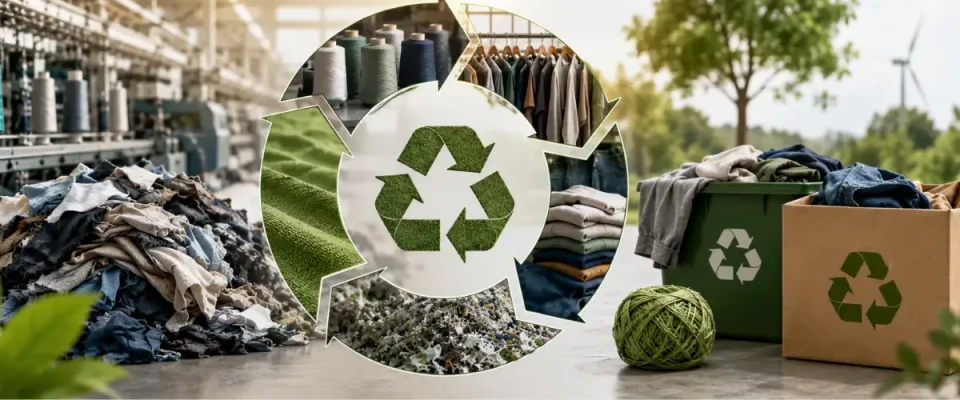
To address these challenges, industry stakeholders are increasingly embracing circular economy principles that focus on reducing waste, extending product life, and recovering valuable materials.
A circular textile economy seeks to keep fibers, fabrics, and garments in use for as long as possible through reuse, repair, refurbishment, and recycling.
Instead of following the traditional “take-make-dispose” model, circular systems aim to create closed-loop supply chains where materials are continuously recovered and reused.
Emerging Opportunities in Textile Waste Management
Advanced Textile Recycling Technologies
Innovations in mechanical and chemical recycling are making it possible to recover fibers from used garments and manufacturing waste more efficiently than ever before.
Chemical recycling technologies, in particular, show promise in separating blended materials and producing high-quality recycled fibers suitable for new textile products.
Growing Demand for Recycled Fibers
Global brands are increasingly incorporating recycled content into their products to meet sustainability commitments and consumer expectations.
This trend is creating new markets for recycled fibers and encouraging investment in textile recycling infrastructure.
Sustainable Business Models
Rental, resale, repair, and take-back programs are gaining popularity across the fashion industry. These business models help extend product lifecycles while reducing waste generation.
Many leading brands now offer collection programs that encourage consumers to return used garments for reuse or recycling.
Digital Technologies for Waste Reduction
Artificial intelligence, automation, and digital product passports are improving waste tracking, material identification, and recycling efficiency throughout the textile supply chain.
These technologies can help manufacturers optimize production processes and minimize material losses.
Government Regulations and Policy Support
Governments worldwide are introducing regulations aimed at improving textile sustainability. Extended Producer Responsibility (EPR) programs, recycling targets, and waste reduction initiatives are encouraging companies to take greater responsibility for end-of-life products.
Such policies are expected to accelerate investment in recycling infrastructure and circular textile solutions.
The Role of Manufacturers
Textile manufacturers play a critical role in reducing waste generation. By adopting sustainable production practices, improving material efficiency, and designing products for recyclability, manufacturers can significantly reduce their environmental impact.
Strategies such as zero-waste pattern cutting, fabric optimization, and the use of mono-material designs can help simplify recycling processes while minimizing waste.
Manufacturers that prioritize sustainability are also better positioned to meet evolving customer expectations and regulatory requirements.
Future Outlook
The future of textile waste management will depend on collaboration across the entire value chain, including fiber producers, manufacturers, brands, retailers, consumers, recyclers, and policymakers.
Advances in recycling technologies, stronger regulatory frameworks, and growing consumer demand for sustainable products are creating momentum toward a more circular textile industry.
While significant challenges remain, the opportunities are equally substantial. Companies that invest early in waste reduction, recycling infrastructure, and circular business models will be well positioned to gain competitive advantages in an increasingly sustainability-focused marketplace.
Conclusion
Textile waste management is no longer simply an environmental issue—it is a strategic business challenge and opportunity. As the industry faces increasing pressure to improve sustainability performance, effective waste management solutions will become essential for long-term success.
By embracing innovation, circular economy principles, and collaborative approaches, the textile industry can transform waste from a growing problem into a valuable resource, creating economic, environmental, and social benefits for future generations.