
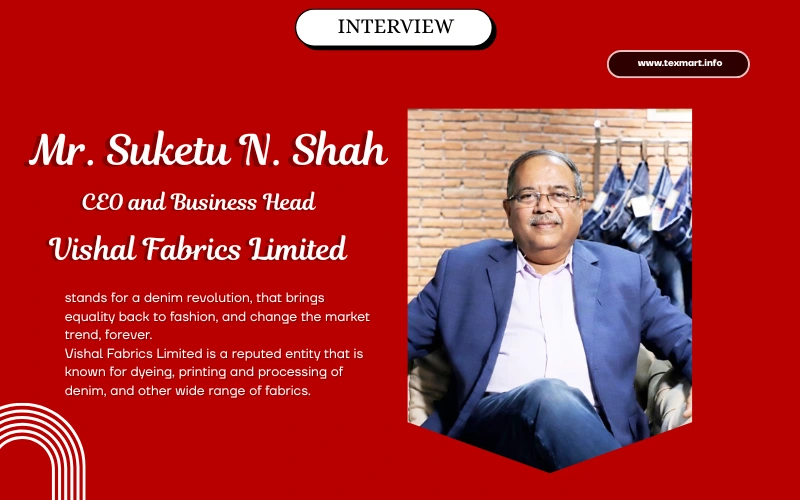
Read our exclusive interview with Suketu N. Shah, CEO and Business Head of Vishal Fabrics Limited, on denim innovation, fabric manufacturing, sustainability, and the future of textiles.
TexMart : What was the original vision behind establishing Vishal Fabrics in 1985 and how has it influenced the company’s long-term growth and success?
Suketu N. Shah : Vishal Fabrics was born from a simple conviction: India deserved world-class denim. Founded in 1985 as part of the Chiripal Group, our objective was to build more than a processing unit -to set the benchmark for quality and consistency in Indian denim. Over four decades that conviction has strengthened. What began as a fabric processor has become an integrated denim manufacturer with a combined capacity of 195 million metres per annum -90 MMPA at Dholi and 105 MMPA at Narol. Every strategic investment and technology adoption has been guided by that founding belief: deliver more than expected, every time. Having spent over 40 years in the industry across LNJ Denim, Raymond UCO Denim, Aarvee Denims and Arvind, I recognise what sets VFL apart -the founding vision has been amplified, not diluted, by growth. I joined at an inflection point, and I believe the best chapters are still ahead.
TM : As part of the Chiripal Group, how has the organisation’s entrepreneurial culture and long-term outlook influenced Vishal Fabrics’ growth and market positioning?
SNS : The Chiripal Group is values-driven at its core. That culture instils long-horizon thinking across every company under it -VFL is no exception. We don’t make decisions quarter to quarter; we plan for a decade and beyond. That long-term outlook gives VFL the courage to invest heavily in infrastructure when markets are uncertain, to commit to sustainability before it becomes a regulatory requirement, and to pursue manufacturing excellence at a scale most competitors can’t match.
This entrepreneurial DNA also shows up in agility. We add 40-plus new designs every month -a pace that only works when innovation is embedded at every level, from the design lab to the weaving floor. For investors and business partners, that means VFL is both stable and dynamic -rare in a capital-intensive sector like denim.
TM : What were some of the key challenges and turning points that helped transform Vishal Fabrics from a processing unit into a recognized denim manufacturing brand?
SNS : Early on, the market leaned toward low-cost sourcing from China, Bangladesh and Indonesia. We answered by competing on capability rather than price. Investing in scale -464 weaving looms, 11 warping units, 8 dyeing machines and a DSIPL Denim unit -signalled our intent to be an industrial player. Moving into wider-width fabrics gave us a technical edge; the ₹198 crore Dholi expansion (₹71 crore prepaid to reduce finance cost) demonstrates disciplined capital allocation. Investments such as a 6 MW captive power plant and a 0.999 MW rooftop solar installation reinforced operational self-reliance and sustainability. Those choices turned a processing unit into a trusted supplier for global brands.
TM : Vishal Fabrics offers a wide range of denim fabrics across different blends, weights, and finishes. How do you ensure product innovation while maintaining consistent quality standards?
SNS : Our portfolio is built on breadth and precision. We manufacture denim in 100% cotton, cotton-spandex, cotton-poly, cotton-poly-spandex, cotton-modal, and cotton-tencel -covering virtually every blend the global market demands. Stretch denim is a strong growth category for us, given its universal appeal across age groups and uses.
Quality consistency at 195 MMPA isn’t accidental -it’s engineered. We’ve invested in 14 inspection machines, Foam Finish machines with dobby and cam combinations from Tsudakoma, singeing and mercerising units, and advanced wet finishing lines. Every metre goes through a rigorous quality control chain. Our certifications -ISO 9001:2015, ISO 14001:2015, OEKO-TEX, BCI, and GOTS -aren’t just badges on a letterhead; they’re living commitments embedded in our SOPs. When a buyer in Europe or North America sources from VFL, they have the assurance of internationally audited quality at every step.
TM : Your manufacturing facilities utilise advanced weaving, dyeing, finishing, and processing technologies. How have these investments enhanced productivity and customer satisfaction?
SNS : Technology at VFL is a strategic imperative -not a capital expenditure line item. Our Continuous Bleaching Range unit, Rotary Screen Printing Machine, Continuous and Loop Agers, Hydro Extractors, Sanforizing Machine, Liza Brushing Machine, and Sueding Machine are not legacy assets; they’re platforms for competitive advantage. Together, they allow us to handle the full spectrum of denim processing in-house, reducing turnaround times and giving us complete quality control across the value chain.
For our customers -whether domestic brands or global retail chains -this translates into reliable lead times, lower rejection rates, and the flexibility to accommodate customised specifications at scale. We’re deploying automation and AI-driven processes to further minimise variability, improve efficiency, and enable faster new product development. Our goal is to ensure that a buying decision for VFL fabric is always an easy one -because our systems make delivery predictable and quality non-negotiable.
TM : With increasing demand for functional and performance fabrics, what emerging product categories or fabric solutions are currently gaining momentum within your portfolio?
SNS : Today’s denim buyer wants fabrics that perform. We’re seeing demand for stretch and recovery, moisture management, odour control and UV protection. At VFL we’re integrating advanced finishing chemistries and selective nanotech to deliver functionality without sacrificing aesthetics. Sustainable lines -BCI cotton, GOTS-compliant processes, and recycled inputs -are gaining commercial traction. We also recycle excess cotton fibres into denim bags, mats and covers as an early circular step, and we’re piloting digital textile printing and 3D visualisation to shorten the design-to-sample cycle for fast-fashion clients.
TM : Consumer preferences in denim continue to evolve rapidly. How does Vishal Fabrics identify changing market trends and translate them into commercially successful fabric collections?
SNS : Trend intelligence at VFL is continuous and multi-channel. We track global runway trends, retail sell-through data from key markets, and consumer behaviour shifts through our international partners. We complement this with direct dialogue with brand clients -understanding not just what they’re buying today but what they’re planning six to eighteen months out. That gives us a forward-looking view, letting us develop fabric collections ahead of the demand curve rather than in reaction to it. Commercial validation happens through our sampling and design iteration process, where we move from concept to physical sample rapidly thanks to in-house manufacturing depth.
Adding 40-plus new designs every month proves this engine is running at full speed. We focus on collections that are both creatively compelling and commercially viable -the sweet spot where design meets manufacturability at scale.
TM : India is becoming an increasingly important hub for global textile sourcing. What opportunities do you see for Indian denim manufacturers in international markets over the next few years?
SNS : The structural shift in global sourcing is the most significant tailwind Indian textile manufacturers have seen in a generation. As brands diversify away from single-country dependency and seek reliable, high-quality, ethically compliant supply chains, India is uniquely positioned. We have the raw material base, manufacturing scale, regulatory framework for compliance, and increasingly the technology sophistication to compete at the highest global level.
For VFL specifically, alignment with India’s export vision -supported by international certifications and zero-discharge, solar-powered manufacturing -makes us an attractive partner for brands in Europe, North America, and developing markets where our cost-competitiveness is a significant advantage. The India-UAE CEPA, potential FTAs with the UK and EU, and shifting tariff dynamics vis-à-vis China all create a window we intend to capture decisively.
TM : How do innovation, design flexibility, and customisation help Vishal Fabrics differentiate itself in a highly competitive textile marketplace?
SNS : In a commodity market, differentiation is existential. At VFL, we’ve built it on three pillars: manufacturing breadth, customisation capability, and sustainable compliance. Our ability to produce wider-width fabrics -a first-mover advantage in India -allows customers to achieve better fabric utilization and reduce garment waste. Our customisation capability, backed by a large in-house design team and rapid sampling infrastructure, means that even brands with specific creative visions can bring ideas to life with us at industrial scale.
Sustainability compliance is an increasingly non-negotiable differentiator in export markets. Our GOTS, OEKO-TEX, and BCI certifications, combined with our Zero Discharge facility and renewable energy integration, ensure that sourcing from VFL allows brands to meet their own ESG commitments. This isn’t a feature -it’s a strategic advantage that becomes more valuable every year as regulatory pressure and consumer scrutiny on supply chains intensify.
TM : With decades of industry experience, what strategic initiatives have played the most significant role in strengthening Vishal Fabrics’ position within the denim value chain?
SNS : Three strategic choices stand out. First, commitment to scale: investing in 195 MMPA combined capacity -including the ₹198 crore Dholi expansion -has given VFL the volume credentials major global brands require before committing a significant share of wallet. You can’t be taken seriously as a strategic supplier if you can’t guarantee supply continuity.
Second, integrating sustainability as a business driver rather than a cost centre. Our Zero Discharge facility, rooftop solar, and eco-certified processes reduce operational costs over time while opening doors to premium, sustainability-conscious buyers. Third, relentless focus on product innovation -adding 40-plus new designs monthly -ensures our relevance to buyers is renewed constantly. In a fashion-driven category like denim, standing still is moving backwards.
TM : The company has developed large-scale manufacturing capabilities. How do you balance operational efficiency, quality assurance, and sustainable growth while expanding production capacity?
SNS : The prepayment of ₹71 crore from the Dholi expansion financing illustrates how we think about this balance. We invest for growth but with financial discipline that keeps the balance sheet healthy and interest costs manageable. Operational efficiency comes from continuous investment in automation -automated loom monitoring, AI-assisted quality inspection, and digital process controls that reduce human error and increase throughput consistency.
Quality assurance at scale requires systems, not just supervision. Our 14 inspection machines and internationally audited ISO processes ensure quality is built in at every production stage rather than inspected at the end. For sustainable growth, our captive power infrastructure -the 6 MW plant and rooftop solar -insulates us from energy cost volatility, while our water recycling systems ensure expansion doesn’t come at an environmental cost. This is how you grow responsibly in the textile sector today.
TM : What lessons from your business journey would you share with emerging textile manufacturers seeking long-term success in today’s competitive environment?
SNS : Four decades in this industry -across LNJ Denim, Mafatlal, Aarvee, APAC Inti Corpora, Raymond UCO, Arvind, and now VFL -have taught me that companies which endure never stop investing in their fundamentals: quality, technology, and people. Don’t treat compliance and sustainability as overhead; treat them as competitive infrastructure. The brands you want to supply to increasingly make sourcing decisions based on environmental and ethical credentials, not just price.
Build for scale, but manage your balance sheet with the same rigour you apply to your production floor. And above all, build a culture that’s genuinely customer-first -not in the marketing sense, but operationally. When a buyer has a problem, your response time and solution quality are what they remember, not your brochure. That builds long-term partnerships, and long-term partnerships are the foundation of a sustainable business.
TM : As global supply chains continue to diversify, how do you foresee India’s textile and denim industry strengthening its position as a preferred manufacturing destination?
SNS : India’s moment in global textile sourcing isn’t a cyclical uptick -it’s a structural repositioning. The combination of China+1 sourcing strategies, the PLI scheme for textiles, improving port and logistics infrastructure, and a large skilled manufacturing workforce makes India a compelling long-term bet. For denim specifically, India is already among the top five global producers, and with the right policy tailwinds, I see no reason we can’t be firmly in the top two within this decade.
What will differentiate Indian manufacturers in this race is the ability to deliver quality at global standards -not just competitive pricing. That means investing in technology, certifications, and talent. VFL is already on that path, and we see Bharat Tex 2026 as precisely the kind of platform where India’s manufacturing ambition can be showcased to the world’s sourcing community.
TM : Which emerging trends -such as sustainable materials, circular fashion, or technical textiles -are likely to drive the next phase of growth for the Indian textile sector?
SNS : Three mega-trends will define the next decade. First, sustainability -the transition to eco-certified, low-impact production is not optional for manufacturers who want access to premium global markets. Second, the rise of functional and performance fabrics -as lifestyle categories blur, consumers want denim that works as hard as they do. Technical finishing, stretch performance, and smart fabric properties will become mainstream rather than niche.
Third, digital integration -from AI-assisted design to 3D virtual sampling, the manufacturers who can compress the design-to-delivery cycle will win disproportionate market share.
The circular economy is also an area we’re watching closely. The EU’s extended producer responsibility regulations and growing consumer awareness of fashion’s environmental footprint are creating commercial opportunity for manufacturers who can offer recycled-content fabrics and closed-loop production models. VFL’s existing circular initiatives -recycling cotton fibre into secondary products -are early steps on a longer journey.