


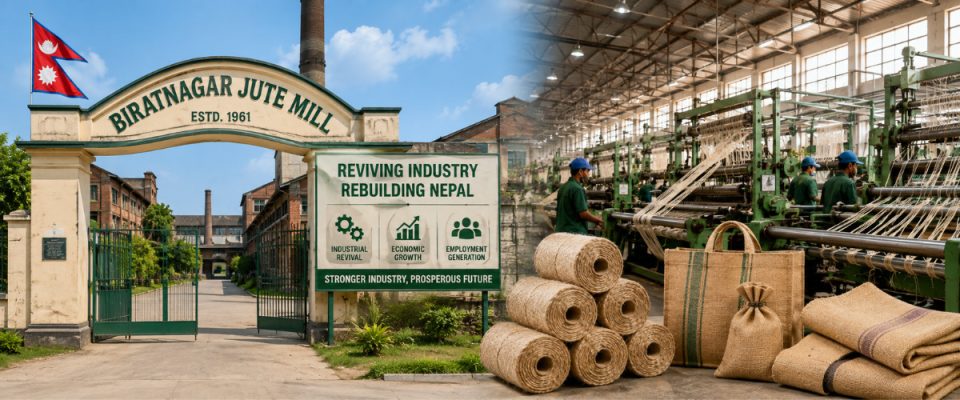
The government has formed a task force to assess the financial, technical and legal feasibility of reopening Nepal’s historic Biratnagar Jute Mill.
Nepal’s government has started preparations to revive the long-shuttered Biratnagar Jute Mill, one of the country’s oldest industrial establishments. The move follows the recent restart of the Hetauda Textile Industry and forms part of a broader government programme to bring closed industries back into operation.
The government has formed a task force of experts to examine the mill’s financial, technical and legal feasibility. The team will assess the condition of the factory’s buildings, machinery and other infrastructure before preparing a detailed revival plan. The task force has been given one month to submit its recommendations.
Established in 1936, Biratnagar Jute Mill is regarded as Nepal’s first industrial establishment. Before 1992, the mill was producing approximately 45 tonnes of jute products per day, but it subsequently faced repeated shutdowns and operational difficulties.
A preliminary assessment estimates that around NPR 1.5 billion–2 billion could be required to restore the mill. The government will also need to address outstanding wage payments of more than NPR 30 million owed to 46 former contract workers.
The revival plan is part of Nepal’s FY2026/27 budget strategy to revive seven closed industries through public-private partnerships within one year. The government sees private-sector participation as an important component of restoring state-linked industrial assets and strengthening domestic manufacturing.
For the jute and sustainable packaging industry, the potential reopening could be significant. Jute is a natural fibre widely used in sacks, bags, twine, ropes, mats and other packaging products, providing an alternative material for several applications traditionally served by synthetic materials.
The development also comes as Nepal looks to strengthen domestic manufacturing and make greater use of its agricultural and natural-fibre resources. A modernised jute mill could potentially create opportunities across jute cultivation, fibre processing, spinning, weaving and finished-product manufacturing.
The proposed revival of Biratnagar Jute Mill therefore represents more than the reopening of an old factory. If the feasibility study supports investment, the project could help restore industrial employment, strengthen Nepal’s jute value chain and create new opportunities for natural-fibre and sustainable packaging products.