


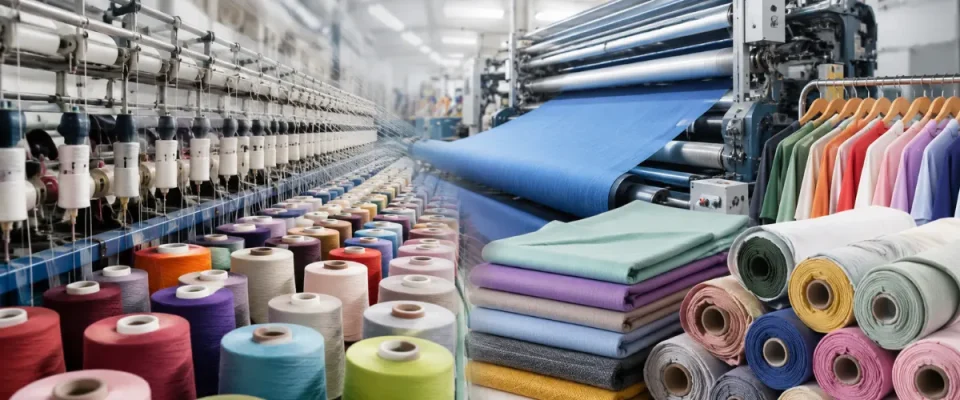
PM MITRA Parks emerge as catalyst for India’s textile transformation
India’s textile industry, long recognized for its rich heritage and economic significance, is undergoing a major transformation through the PM Mega Integrated Textile Region and Apparel (PM MITRA) scheme. Designed to strengthen the entire textile value chain, the initiative aims to overcome long-standing challenges of fragmentation, high logistics costs, and sustainability concerns while positioning India as a global textile powerhouse.
The textile sector contributes approximately 2.3 per cent to India’s GDP, 13 per cent to industrial production, and 12 per cent to exports. It directly employs around 45 million people and supports more than 100 million livelihoods indirectly, making it the country’s second-largest employer after agriculture.
Historically, India’s textile value chain has been geographically dispersed, with spinning, weaving, processing, garment manufacturing, and export operations spread across different regions. This fragmented structure has increased transportation costs, slowed production cycles, and limited opportunities for scale, modernization, and productivity improvements.
To address these challenges, the Government of India launched the PM MITRA scheme in October 2021 with a budget allocation of ₹4,445 crore. The initiative promotes integrated textile ecosystems where manufacturing activities are co-located within large industrial parks, reducing logistics costs and improving operational efficiency.
The scheme is built around Prime Minister Narendra Modi’s 5F vision—Farm to Fibre, Fibre to Factory, Factory to Fashion, and Fashion to Foreign. The approach seeks to strengthen India’s complete textile value chain, from raw material production to global exports, while ensuring inclusive growth for farmers, weavers, manufacturers, and exporters.
Strategically located near major raw material hubs, PM MITRA parks are expected to reduce transportation expenses, improve supply chain traceability, and support compliance with international sustainability and ESG standards. Integrated facilities, including Common Effluent Treatment Plants with Zero Liquid Discharge (ZLD) technology, are also aimed at enhancing environmental performance and responsible manufacturing practices.
The PM MITRA scheme includes seven textile parks across the country. Five greenfield parks are being developed in Virudhunagar (Tamil Nadu), Navsari (Gujarat), Kalaburagi (Karnataka), Dhar (Madhya Pradesh), and Lucknow (Uttar Pradesh), while two brownfield parks are located in Warangal (Telangana) and Amravati (Maharashtra).
According to official data, the scheme has attracted investment interest worth over ₹69,899 crore, with grounded investments of ₹27,658 crore. The first operational PM MITRA park was inaugurated in Warangal, Telangana, on May 10, 2026, with investments totaling ₹3,862 crore.
Implementation progress has accelerated across all seven locations, supported by completed land acquisition, environmental clearances, and partnerships between central and state governments. Dhar in Madhya Pradesh, spanning 2,158 acres, has recorded the highest investment interest at ₹21,436.9 crore. Significant commitments have also been reported from Gujarat, Maharashtra, Tamil Nadu, Uttar Pradesh, and Karnataka.
Beyond infrastructure and investment, the initiative is expected to generate substantial employment opportunities. Each PM MITRA park is projected to create around 300,000 direct and indirect jobs, resulting in more than 2.1 million employment opportunities across all seven locations. The scheme is also expected to enhance economic participation for women, who represent a significant share of the textile and apparel workforce.
As India pursues its Vision 2030 goal of building a $350 billion textile industry, PM MITRA parks are set to play a pivotal role in strengthening competitiveness, sustainability, and global market access. By creating integrated manufacturing ecosystems and modern infrastructure, the initiative aims to transform India into a leading global hub for textile and apparel production.