
Vietnam’s Textile and Garment Industry Accelerates Green Transformation to Sustain Export Growth
Vietnam’s textile and garment industry is accelerating its shift towards green production, technological innovation and higher-value manufacturing as international brands increasingly demand sustainability, traceability and responsible supply chains.
While competitive pricing and production capacity have traditionally supported Vietnam’s position as a major global sourcing hub, these factors are no longer sufficient on their own. Businesses are now under growing pressure to reduce emissions, adopt cleaner energy, use sustainable raw materials and improve transparency across their supply chains.
Green Transformation Becomes a Competitive Imperative
According to Vietnam’s Ministry of Industry and Trade, textile and garment exports are expected to reach US$46 billion in 2025, with the industry targeting US$48 billion in 2026.
By August 2026, textile and garment export turnover had reached approximately US$26.9 billion, up 1.6% from the same period last year.
The performance highlights the industry’s continued competitiveness, but companies are simultaneously facing higher production costs, changing trade policies and increasingly stringent requirements related to emissions, sustainability and circularity.
Global fashion brands are also changing how they evaluate suppliers. According to Alen Wei, Chief Financial Officer of H&M Production China and Southeast Asia, brands are increasingly looking for supply partners that can demonstrate sustainability, innovation, resilience and long-term value creation alongside competitive pricing and quality.
For suppliers, this means addressing a wider range of requirements covering raw materials, energy, chemicals, environmental impact, labour conditions and supply-chain responsibility.
Recycled Materials and Circularity Gain Importance
The growing focus on emissions is particularly relevant to the textile and apparel industry because of its substantial consumption of energy and raw materials.
The global fashion industry produces more than 100 billion garments annually, with polyester accounting for more than 60% of fibre use, while the sector generates an estimated 92 million tonnes of textile waste each year.
As a result, recycled materials, longer product lifecycles and circular production models are becoming increasingly important to global buyers.
Vietnam is already an important sourcing base for international fashion groups. H&M has sourced products from Vietnam for more than two decades and currently works with more than 40 suppliers operating over 70 factories and employing more than 60,000 workers across the country.
This established position gives Vietnam a strong foundation, but suppliers will need to adapt quickly to the evolving sustainability expectations of global brands.
Vietnam Remains a Strategic Sourcing Hub
International buyers participating in the Vietnam International Sourcing 2026 event in Ho Chi Minh City have highlighted Vietnam’s established strengths in production capacity, workforce availability, supply-chain integration and adaptability.
However, the next stage of development is expected to involve a transition from being primarily a manufacturing base towards becoming a hub for green, high-tech, circular and high-value-added textile production.
This shift is becoming increasingly important as major brands seek suppliers capable of combining price competitiveness with quality, speed, innovation and environmental responsibility.
Trade Policies Add to Competitive Pressure
Alongside sustainability requirements, Vietnamese textile manufacturers are also navigating changes in international trade policies.
Do Ngoc Hung, Commercial Counselor and Head of the Vietnamese Trade Office in the United States, noted that tariffs imposed by the US on various economies could affect consumer and importer purchasing power and potentially put pressure on the price competitiveness of Vietnamese exports.
However, major US buyers and distributors have so far shown no major intention to change their sourcing partners, with Vietnam continuing to be viewed as a strategic manufacturing base across textiles, footwear and other labour-intensive industries.
This presents an opportunity for Vietnamese companies, but also highlights the need to strengthen their competitive advantages beyond low production costs.
Businesses are being encouraged to increase domestic sourcing of raw materials and technology, improve production capabilities and generate greater domestic value addition. Such measures could also help reduce exposure to trade-defence investigations and concerns over unclear or third-country sourcing.
Companies Invest in Integrated Production
Vietnamese textile companies are increasingly responding by making green transformation and innovation part of their broader business strategies.
Corporation 28, for example, operates an integrated production chain covering yarn spinning, weaving, dyeing, finishing, garment manufacturing and direct distribution.
The company has annual production capacity of around 2,500 tonnes of yarn, 3 million metres of tie-dye fabric and 18 million metres of dyed fabric. Its products are exported to markets including the US, EU and Japan, generating annual export revenue of approximately US$90–100 million.
According to Nguyen Thi Hong Trang, Deputy Head of the Research, Development and Investment Department at Corporation 28, international customers are increasingly prioritising sustainability across raw materials, energy use and working conditions.
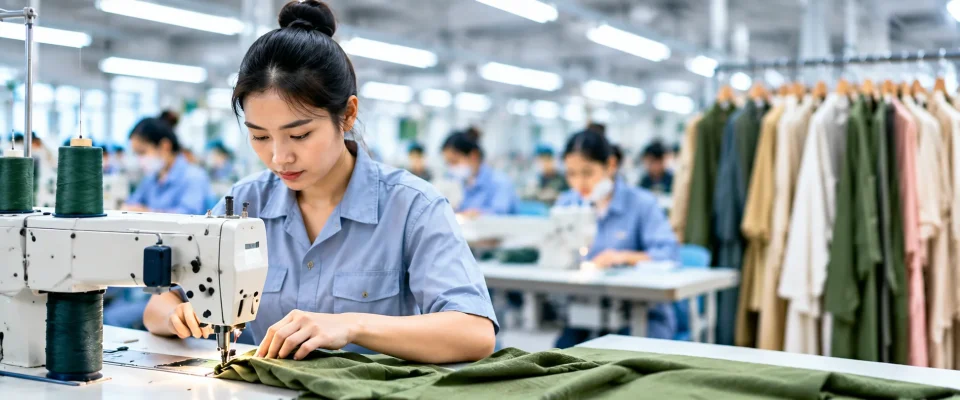
In response, the company is investing in modern equipment, improving production processes and introducing automation across stages including design, fabric laying, cutting, sewing and finishing.
The objective is not only to meet current environmental requirements but also to improve productivity, optimise raw-material use and strengthen long-term export competitiveness.
Faslink Focuses on Sustainable Materials and Technology
Faslink Vietnam is taking a different approach by focusing on sustainable materials, recycling and technology-driven production solutions.
According to Tran Hoang Phu Xuan, Director of Faslink Vietnam, the company has evolved from simply manufacturing textile products towards providing broader material and production solutions for fashion brands.
Its portfolio includes fabrics made from natural and alternative sources such as bamboo, lotus, coffee and mint fibres.
The company is also applying 3D technology to accelerate sample development and reduce material waste. Big-data analytics is being used to forecast market trends, while circular solutions include recycling used garments into new products.
Faslink estimates that collaborative recycling solutions can reduce CO₂ emissions by approximately 59% and water consumption by 47% compared with conventional production processes.
The approach has helped the company become a supplier of materials and production solutions to more than 60 fashion brands, while also supplying uniforms to more than 500 businesses in Vietnam.
Supply-Chain Transformation Key to Future Growth
For Vietnam’s textile and garment industry, green transformation is increasingly becoming a question of competitiveness and order retention, rather than simply environmental compliance.
As international brands restructure their sourcing networks around sustainability, flexibility, traceability and lower emissions, Vietnamese manufacturers have an opportunity to strengthen their position—but only if they move further up the value chain.
Industry experts recommend greater investment in design, product development, supply-chain management and domestic raw-material sourcing, alongside improvements in workforce skills, digital technologies, automation, trend forecasting and data management.
The focus is therefore shifting from producing larger volumes to creating greater value across every stage of the textile and garment supply chain.
With Vietnam already firmly established among the world’s major textile and garment manufacturing centres, the industry’s next phase will depend on how effectively businesses combine manufacturing scale with sustainability, technology, innovation and higher-value production.