


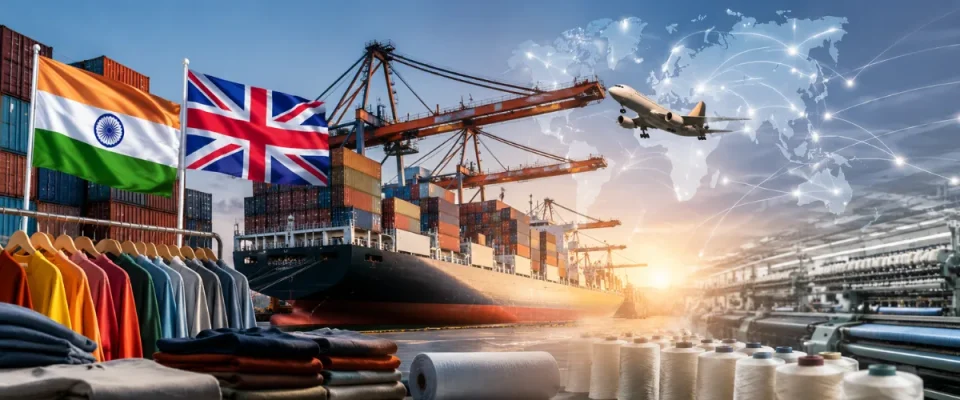
India Textile Exports Poised for Growth Amid China+1 Shift and UK Trade Agreement
India’s textile and apparel industry is poised for significant growth as shifting global sourcing trends, recovering consumer demand, and the recently concluded India-UK Free Trade Agreement (FTA) create new export opportunities, according to a report by Motilal Oswal.
The report highlights improving market conditions across key apparel-consuming regions, including the United States and Europe, where retailers and brands are witnessing stabilizing inventory levels, stronger sell-through rates, and a gradual recovery in discretionary spending. These developments are expected to support healthier ordering cycles and increased sourcing activity, benefiting textile manufacturers and exporters.
As global demand strengthens, Indian textile companies are likely to experience higher order volumes, improved capacity utilization, and stronger margin visibility across the value chain.
A key growth driver identified in the report is the India-UK Free Trade Agreement, which is expected to enhance the competitiveness of Indian apparel exports in one of the world’s largest clothing import markets. The United Kingdom imports nearly US$20 billion worth of apparel annually, yet India currently accounts for only a small portion of this market.
Historically, Indian exporters have faced an import duty disadvantage of 8% to 12% compared with countries such as Bangladesh, Turkey, and Cambodia, which enjoy preferential market access. The proposed elimination of these duties under the FTA is expected to level the playing field and significantly improve India’s position in the UK apparel market.
The report also points to the gradual decline in China’s dominance of global apparel exports as a major opportunity for India. China’s share of global apparel exports has fallen from 37% in 2014 to 29% in 2024, creating space for alternative sourcing destinations to expand their global presence.
India is increasingly emerging as a preferred sourcing hub, supported by favorable trade agreements, government initiatives such as the Production Linked Incentive (PLI) Scheme for Textiles, and ongoing investments in manufacturing infrastructure and capacity expansion.
The continued adoption of the China+1 sourcing strategy by international brands, combined with rising labor costs in China, is further strengthening India’s appeal within global supply chains. Industry analysts believe Indian exporters are well positioned to capture a larger share of international apparel trade as brands seek to diversify sourcing networks and reduce dependence on a single market.
Beyond the UK, opportunities are also growing in the United States. China’s share of US apparel imports declined from 37% in 2019 to 22% in 2023, reflecting the ongoing diversification of sourcing strategies among global buyers.
While countries such as Bangladesh and Vietnam continue to benefit from cost advantages and established trade agreements, India is steadily enhancing its competitiveness through policy support, manufacturing scale, infrastructure development, and strategic trade partnerships.
According to the report, the combination of favorable trade agreements, government-backed initiatives, expanding production capabilities, and shifting global sourcing patterns positions India’s textile and apparel sector for sustained export growth in the years ahead.