


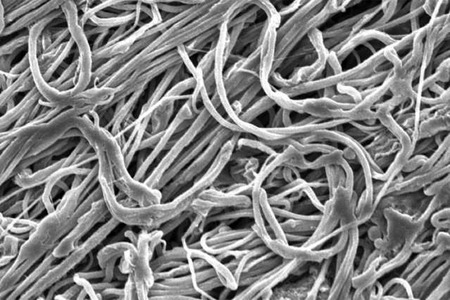
Researchers at University College London (UCL) have developed a more sustainable alternative to nanofiber nonwovens by creating nanofibres directly from starch-rich ingredients like flour. In their study published in Nanoscale Advances, they describe using electrospinning to produce nanofibres as thin as 372 nanometres, far smaller than a human hair.
“To make spaghetti, you push a mix of flour and water through holes, and we did something similar, except we used an electric charge to pull the mixture,” explained Dr. Adam Clancy of UCL Chemistry. “It’s essentially spaghetti, but on a much smaller scale.” While a 2 cm mat of these nanofibres is visible to the naked eye, individual strands are too fine to be observed with standard cameras or microscopes. Instead, the researchers used a scanning electron microscope to measure their dimensions.
“Starch is abundant, renewable, and biodegradable, making it an ideal material for these applications,” said Dr. Clancy. “However, purifying starch requires intensive processing. Our study shows a simpler way to produce nanofibres using flour. The next step is to explore its properties, such as degradation rates, cellular interactions, and scalability.”
The work was led by Beatrice Britton as part of her master’s degree in chemistry at UCL. “I enjoyed the process of experimenting with variables to refine the mixture,” she said. “There was a lot of trial and error, but I was thrilled to successfully form nanofibres.”