


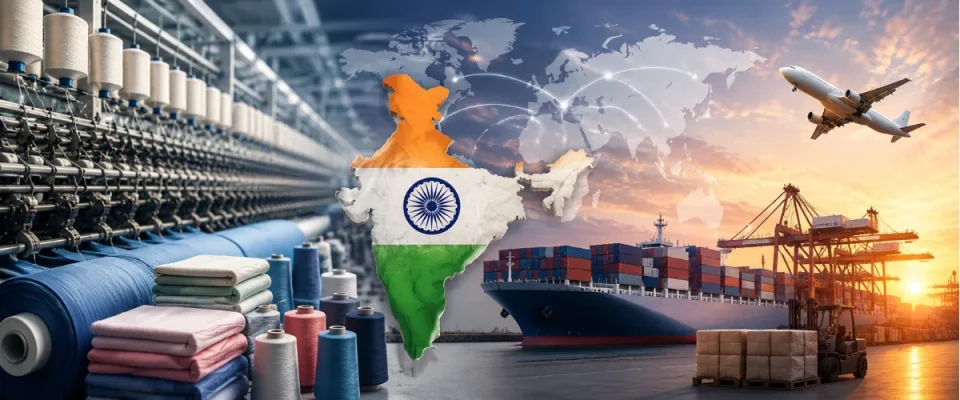
India’s Textile Industry Poised for Long-Term Growth as Global Sourcing Shift Accelerates
India’s textile industry is entering a promising phase of growth, driven by a combination of recovering global demand and a significant shift in international sourcing strategies. According to Siddhartha Khemka, Head of Retail Research at Motilal Oswal Financial Services, the larger opportunity lies in the long-term transformation of global supply chains as brands increasingly diversify manufacturing away from China.
Speaking on the outlook for the sector, Khemka noted that while inventory normalization in major export markets such as the United States and Europe is supporting near-term demand recovery, the structural changes taking place across global sourcing networks are likely to have a much bigger impact over the coming decade.
Retailers in developed markets spent the last two years reducing excess inventories accumulated during the post-pandemic period. With inventory-to-sales ratios now returning to normal levels, ordering activity has gradually started recovering, providing a cyclical boost to textile exports.
However, industry analysts believe the more significant opportunity comes from the ongoing “China Plus One” strategy being adopted by global apparel brands. Rising manufacturing costs, geopolitical tensions, compliance requirements, and supply chain diversification efforts are prompting international retailers to reduce dependence on China and expand sourcing from alternative destinations.
India appears well-positioned to capitalize on this transition. Despite being one of the world’s largest cotton producers and possessing the second-largest spindle capacity globally, the country currently accounts for only around 4% to 5% of global apparel exports. Industry experts believe this leaves substantial room for growth as international buyers seek reliable and compliant manufacturing partners.
Additional factors are further strengthening India’s position. Political uncertainties in competing textile-exporting nations, restrictions affecting cotton production in China’s Xinjiang region, and growing demand for large-scale compliant suppliers are encouraging brands to diversify sourcing strategies.
Trade agreements are expected to play a crucial role in accelerating this growth trajectory. The India-UK Free Trade Agreement and the proposed India-European Union trade pact could significantly improve India’s competitiveness by narrowing tariff disadvantages currently faced by Indian exporters compared to countries such as Bangladesh and Vietnam.
Industry estimates suggest that Indian textile exports could witness robust growth over the coming years, supported by favorable government policies, expanding manufacturing capacity, and improved market access through trade agreements. Lower tariffs could also influence sourcing decisions of global brands, helping Indian manufacturers capture a larger share of international markets.
Among listed textile companies, Khemka identified Gokaldas Exports as a preferred beneficiary of the ongoing sourcing shift. The company has established relationships with major global brands, continues to expand manufacturing capacity, and is expected to benefit from strong operating leverage as demand improves.
Pearl Global Industries was also highlighted for its diversified manufacturing footprint across India, Bangladesh, Vietnam, and Indonesia, enabling it to cater to changing supply chain requirements of global retailers. KPR Mill remains a high-quality integrated textile player, although analysts believe much of its future earnings potential is already reflected in current valuations.
In the home textiles segment, Indo Count Industries is emerging as another company expected to benefit from improving demand conditions. Growth in bed linen exports, expansion into adjacent product categories, and increasing capacity utilization are expected to support future earnings growth.
As global retailers continue diversifying supply chains and international trade agreements create new opportunities, India is increasingly being viewed as one of the strongest long-term growth stories in the global textile and apparel industry.